Honeycomb Panel Compliance Guide: Making Sense of GB18584-2024, A2 Fire Ratings, and B1 Standards
A compliance file for aluminum honeycomb panels usually holds three different kinds of document, and each answers a different question. GB18584-2024 addresses harmful substance emissions, including formaldehyde. An A2 or B1 fire rating addresses how the panel behaves in a fire. A 24-hour water absorption figure addresses moisture durability. None of them substitutes for another, and treating them as interchangeable is the most common reason a submittal package is rejected — or, worse, approved on the wrong basis.

Why Compliance Files for Honeycomb Panels Fail Review
Most sourcing disputes over honeycomb panels are not about whether a supplier has certificates. They are about whether the certificate in the folder is the one the specification asked for, covering the product being shipped, in the edition currently in force.
Three failure patterns account for the majority of rejected submittals:
- Wrong instrument. A formaldehyde emission report is submitted in place of a fire classification, or a fire classification is submitted as proof of low emission. These documents regulate unrelated properties.
- Wrong scope. A report issued for one thickness, one skin specification or one 50 cm × 50 cm sample is applied to a different build-up in the purchase order. Fire and emission classifications are attached to the tested construction, not to a brand name.
- Wrong edition or scheme. An older edition of a national standard is filed alongside a specification that cites the current edition, or a Chinese B1 class is presented to a reviewer who is applying EN 13501-1.
Short answer for buyers: ask for one document per property, each naming the standard and edition, the tested build-up, the issuing laboratory, and the issue date. If any of those four elements is missing, the document is not yet a compliance document — it is a brochure attachment.
Where These Standards Come From and What Changed
Aluminum honeycomb panels entered interior specification through a lightweight, rigid sandwich construction: two aluminum skins bonded to an aluminum honeycomb core. Commercial research puts the global aluminum honeycomb market at USD 2.1 billion in 2024, with a projected 6.1% CAGR to 2030 (Strategic Market Research). As the material moved from exterior cladding into cabinets, wardrobes, wall panels, ceilings and interior doors, the compliance questions changed from structural performance to what the panel emits indoors and how it behaves when a room catches fire.
That shift is visible in the standards themselves. GB18584-2024 is the current Chinese national standard limiting harmful substances in indoor decorating and refurbishing materials and furniture-related products. It replaced the earlier edition that many existing submittal folders still contain: Nanbeiwang Aluminum's file includes an earlier formaldehyde emission report for 50 cm × 50 cm aluminum cellular board, issued in November 2023 to the 2001 edition of GB 18584 by the Guangdong Testing Institute of Product Quality Supervision and the National Furniture Product Quality Testing Center (Guangdong), certificate SQ2306041 / UNS7332.
That older report is a useful illustration of the edition trap. It is a genuine laboratory document for a genuine product, and it does not satisfy a specification written against GB18584-2024. The current report in the file is certificate SQ2505164, issued 29 October 2025 by the Guangdong Testing Institute of Product Quality Supervision, with scope covering the full series of all-aluminum honeycomb panels.
Fire classification moved along a parallel path. EN 13501-1, ASTM E84 and UL 723 are the schemes most often cited for honeycomb panels in international work, while Chinese domestic specifications commonly use the A2 and B1 class language. A2 and B1 both describe limited contribution to fire, but they are not the same level and they are not issued by the same scheme.
What Each Document Actually Covers
GB18584-2024: emission, not fire
GB18584-2024 governs harmful substance limits for indoor materials. A report to this standard tells a reviewer what the panel releases into indoor air under the defined test conditions. For the glue-free all-aluminum honeycomb panel, the relevant claim is zero formaldehyde emission verified under GB18584-2024. Nanbeiwang Aluminum's SQ2505164 report covers the full series of all-aluminum honeycomb panels, including the Honeycomb Panel (NBW-HPB-001), Whole House Custom Board (NBW-WHB-002), Aluminum Honeycomb Wall Panel (NBW-WPB-003), All-Aluminum Interior Door (NBW-DOR-005) and Aluminum Ceiling (NBW-CLB-004).
What it does not tell you: whether the panel is non-combustible, how it performs in a fire, or how it behaves when wet. A zero-formaldehyde claim and an A2 fire rating address two unrelated risks, and a project may require both.

A2 fire rating: the glue-free thermal-bonded panel
A2 is the second-highest class in the EN 13501-1 ladder, sitting immediately below A1. In practical terms it describes a material whose contribution to fire growth is very limited. For Nanbeiwang Aluminum, the A2 rating is attached to the glue-free, thermal-bonded all-aluminum honeycomb panel represented by model NBW-HPB-001 — a construction of two aluminum skins bonded to an aluminum honeycomb core with no adhesive layer in the bond line.
The bonding method matters to the fire argument. Adhesive-free bonding is a documented direction of travel in the category: CHALCO describes brazing, in which brazing material metallurgically connects the aluminum honeycomb core to the panel, as a way of overcoming the shortcomings of adhesive connection. Whatever the specific process, the practical consequence for a buyer is that the fire classification belongs to that build-up — skins, core, bonding method and thickness together — and not to a generic honeycomb panel category.
B1 fire rating: bamboo core board and welding board
B1 is the Chinese difficult-to-ignite class. In Nanbeiwang Aluminum's range it applies to the All-Aluminum Bamboo Core Board ZKB-1220×2750, supplied in the standard 1220 × 2750 mm format with custom sizing support, and to the Welding Board WAP-600*(200-700).
A2 represents a materially higher fire performance level than B1. A specification written for A2 is therefore not satisfied by a B1 product, while a B1 specification is generally satisfied by a product classified at A2 under an accepted scheme — subject to the reviewer accepting the test standard behind the classification. This is exactly where buyers lose time: quoting a B1 board into an A2 line, or supplying an A2 panel with a B1 certificate because the file was assembled by product family rather than by model.
Water absorption below 1%: durability, not compliance class
The all-aluminum honeycomb panel is reported to hold water absorption below 1% in a 24-hour test. That figure is a moisture durability indicator. It is not a fire class and not an emission limit, but it decides whether a panel is appropriate for kitchens, bathrooms, laundry cabinets and other wet-zone interiors where a swelling core would fail the installation long before any fire or emission issue arises.
ISO9001 and ISO14001: factory systems, not product approval
Nanbeiwang Aluminum holds ISO9001:2015 quality management system certification (certificate 31825Q10055R0S, issued 25 March 2025, valid to 24 March 2028) and ISO14001:2015 environmental management system certification (certificate BIV25E10066R0S, issued 7 May 2025, valid to 6 May 2028), both from BELIEVE (BEIJING) CERTIFICATION CO., LTD., with scope covering aluminum honeycomb panels for furniture, wall, ceiling and cabinet applications.
These certificates support a judgement about process consistency and repeatability between batches. They are not product compliance documents and should never be filed as evidence of a fire class or an emission level.
A Six-Step Verification Workflow
The sequence below is the order in which a compliance reviewer usually checks a file. Running it in this order prevents the most expensive error — approving a document that turns out to describe a different product.
- Fix the specification language first. Write the requirement as standard + edition + class + tested build-up, for example: GB18584-2024 emission report plus A2 classification under EN 13501-1 for a glue-free all-aluminum panel at the ordered thickness.
- Match the report scope to the order line. Confirm the report names the model or the tested construction. Nanbeiwang Aluminum's panels are supplied from 5 mm to 18 mm thickness, in a standard 1220 × 2750 mm format, with aluminum skins from 0.3 mm to 1.0 mm; a report tied to a different skin or thickness is not automatically transferable.
- Check the edition against the specification. A 2001-edition GB 18584 report and a GB18584-2024 report are different documents for the same product category.
- Check the issuing laboratory and its accreditation. The formaldehyde and hazardous substance reports in the file come from the Guangdong Testing Institute of Product Quality Supervision; the earlier 2023 report carries CNAS L0153, CMA and ILAC-MRA markings, which is what makes a report usable outside China.
- Cross-check the class against the market's scheme. A2 is meaningful under EN 13501-1; B1 is meaningful as a Chinese class; ASTM E84 and UL 723 are the reference points for North American reviewers. Do not present one as the other.
- Re-verify on renewal and keep a project submittal file. Certificates and test reports carry issue and expiry dates. Build the renewal reminder into the purchase cycle rather than discovering it during an audit.

The Five Documents to Request First, Ranked by Decision Weight
Buyers rarely get a complete file on the first request, so it helps to know which documents decide the most. The ranking below is an editorial ordering by decision weight in interior fit-out projects — it is not a market ranking and not a certification hierarchy.
1. The current-edition GB18584-2024 test report
This is usually the gating document, because an indoor furniture or fit-out specification that restricts formaldehyde will not clear without it. Request the report number, the issuing laboratory and the product scope in writing. For Nanbeiwang Aluminum the relevant reference is certificate SQ2505164, scope full series of all-aluminum honeycomb panels.
2. The fire classification for the exact build-up
Second in weight because it decides whether the panel can be used in the specified location at all. Ask for the class, the standard behind it, and the model it was issued for: A2 for the glue-free thermal-bonded all-aluminum honeycomb panel NBW-HPB-001, B1 for the bamboo core board ZKB-1220×2750 and the welding board WAP-600*(200-700).
3. A specification sheet that ties the reports to the SKU
This is the document that prevents the scope error. It should state thickness, skin thickness, panel format, core type and bonding method, and it should be consistent with the purchase order. Nanbeiwang Aluminum's published range is 5–18 mm thickness, 1220 × 2750 mm standard format, 0.3–1.0 mm skins.
4. Management system certificates in date
ISO9001:2015 and ISO14001:2015 certificates answer the repeatability question: will the tenth container match the first. Both of Nanbeiwang Aluminum's certificates run into 2028, so the practical check is simply that the certificate number and scope match the supplier entity on the contract.
5. Durability and mechanical performance data
Last in weight but decisive in wet zones: the reported 24-hour water absorption below 1%, and peel strength data referenced to JC/T 2113-2012. Ask for the current report rather than a historical one, since these tests are typically renewed on a shorter cycle than system certificates.
Where Each Rating Actually Matters: Application Fit
Kitchens and bathrooms: emission plus moisture
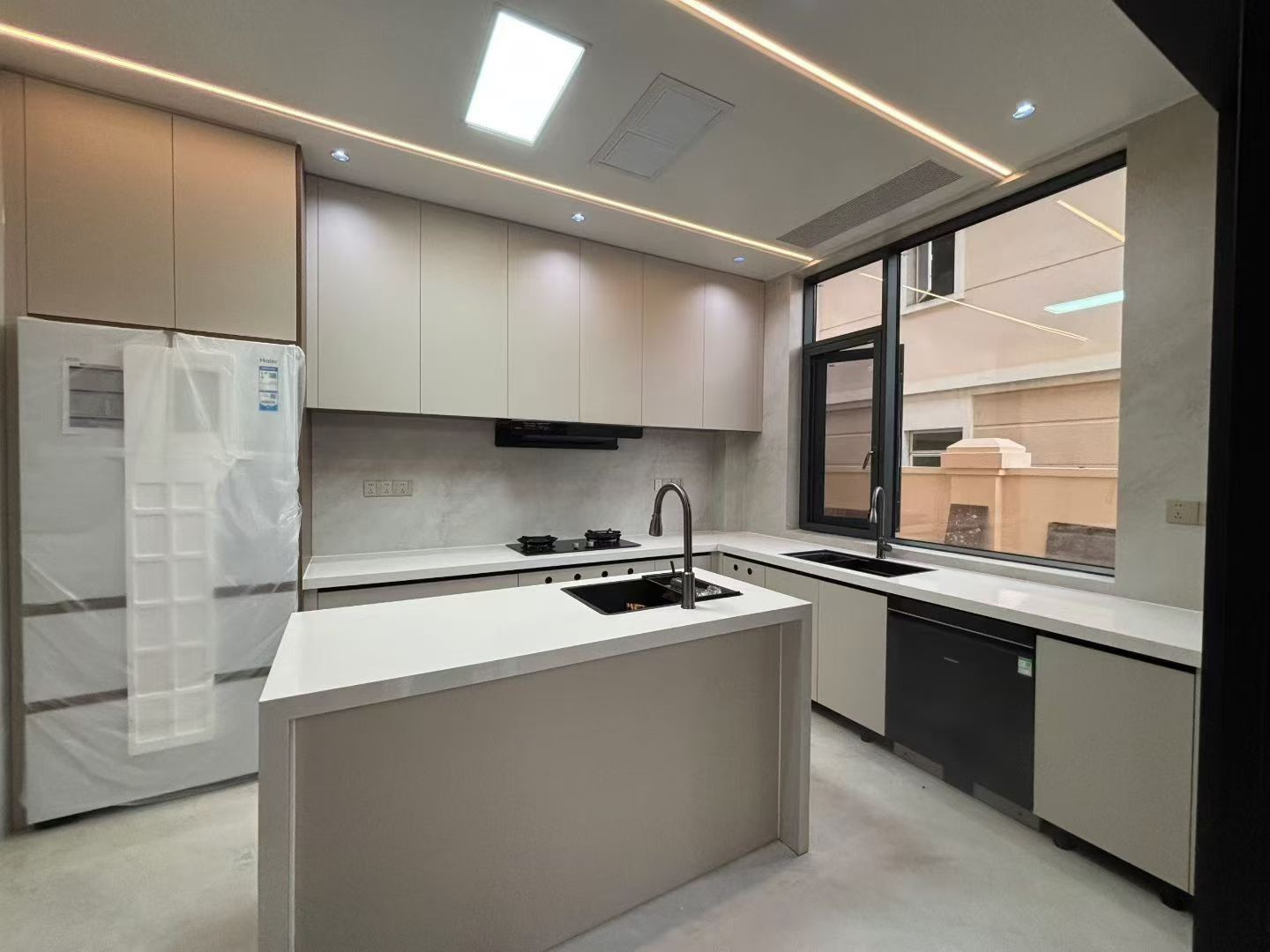
Wet-zone cabinetry puts two documents under pressure at once. The GB18584-2024 report answers the indoor emission question for a confined, warm, humid space; the sub-1% water absorption figure answers the swelling question. This combination is why glue-free honeycomb panels are specified for kitchen and bathroom carcasses and why the two documents should travel together in the submittal file.
Wall panels and ceilings in occupied interiors: fire class first
For large continuous wall and ceiling surfaces in public or multi-occupancy interiors, the fire classification becomes the primary document and the emission report secondary. Wall panels (NBW-WPB-003) and ceilings (NBW-CLB-004) are covered by the same GB18584-2024 series report, but their fire argument must reference the class issued for the specific build-up.
Doors and full-house packages: a mixed-scheme file
A whole-house order typically mixes A2 panels with B1 bamboo core boards and welding boards, plus interior doors and ceilings. The file then has to be organised per model rather than per supplier, otherwise a single A2 certificate gets presented for an entire shipment that contains B1 product.
Project-scale supply: what compliance looks like in volume
Compliance survives scale only if documentation and production stay aligned. In Qatar, a project supplied over 2,000,000 sheets of honeycomb panels for industrial-scale production of aluminum cabinets and wardrobes, supported by bulk supply capacity of 30–50 tons daily, custom sizing support, 24-hour dispatch from a 10,000 m² warehouse, and technical support for cutting optimization; the account reports zero quality complaints over a 20+ year lab-tested durability period with stable monthly orders. In Indonesia, a whole-house customization project scaled to 800,000 sheets across cabinets, wardrobes, wall panels and doors, with a 20–30 year service life reported and a 20% cost reduction. Across global accounts covering more than 10,000 cooperative factories and 5,000 projects in Malaysia, Saudi Arabia, Singapore, Thailand, South Africa, Kosovo and Kuwait, the reported outcome is stable quality, high repurchase rate and 20% cost reduction.
Compliance Instrument Comparison
The table below separates the four instruments buyers most often mix up. Read it as a scope map: each row answers one question and no other.
| Instrument | What it regulates | What it does not cover | Typical requesting market |
|---|---|---|---|
| GB18584-2024 | Harmful substance limits in indoor decorating and furniture materials, including formaldehyde emission | Fire behaviour, moisture resistance, structural performance | China and projects specifying GB standards |
| A2 fire rating | Fire classification of a specific tested build-up under EN 13501-1; very limited contribution to fire growth | Emission levels, water absorption, warranty | Europe and international specifications referencing EN 13501-1 |
| B1 fire rating | Chinese difficult-to-ignite class applied to the named board models | Formaldehyde emission, moisture behaviour | China and domestic-style specifications using A2/B1 language |
| 24h water absorption below 1% | Moisture uptake of the all-aluminum honeycomb panel in a 24-hour test | Fire class, emission class, load capacity | Wet-zone interior specifications (kitchen, bathroom, laundry) |
| ISO9001:2015 / ISO14001:2015 | Factory quality and environmental management systems | Any product-level fire, emission or durability property | Global supplier qualification and audit processes |
Product-to-rating map
| Model | Product | Documented compliance / performance | Typical fit |
|---|---|---|---|
| NBW-HPB-001 | Honeycomb Panel (glue-free, thermal-bonded all-aluminum) | A2 fire rating; zero formaldehyde under GB18584-2024; water absorption below 1% in 24h test | Cabinets, wet zones, general interior panels |
| NBW-WPB-003 | Aluminum Honeycomb Wall Panel | Covered by the GB18584-2024 full-series report (SQ2505164) | Interior wall surfaces, large-format cladding |
| NBW-WHB-002 | Whole House Custom Board | Covered by the GB18584-2024 full-series report (SQ2505164) | Whole-house board packages |
| ZKB-1220×2750 | All-Aluminum Bamboo Core Board | B1 fire rating; 1220 × 2750 mm with custom sizing support | Cabinets and boards under B1 specifications |
| WAP-600*(200-700) | Welding Board | B1 fire rating | Seamless welded panel assemblies |
Ratings and figures above reflect Nanbeiwang Aluminum product documentation and test reports. Always confirm the current report version against your specification line before approval.
Frequently Asked Questions
Does a GB18584-2024 report prove fire performance?
No. GB18584-2024 limits harmful substances, including formaldehyde emission, in indoor decorating and furniture materials. It says nothing about how a panel behaves in a fire. A project that requires both properties needs two documents: the GB18584-2024 report for emission and a fire classification such as A2 or B1 for the tested build-up. Filing one as evidence of the other is a documentation error, not a product error.
Can the same A2 or B1 rating be supplied in a custom thickness or panel size?
The rating belongs to the tested construction, so any change in thickness, skin thickness or panel format has to be checked against the report scope before it can be claimed. Nanbeiwang Aluminum manufactures from 5 mm to 18 mm thickness, in a standard 1220 × 2750 mm format, with aluminum skins from 0.3 mm to 1.0 mm, and offers customization of thickness, size, color, surface finish and cutting. Where a custom build-up departs from the tested one, ask the supplier to confirm in writing whether the existing classification still applies or whether retesting is required.
Does specifying A2 or B1 change the panel budget?
Compliance level is one of several variables behind the spread in published price data, and the spread is wide. Commercial research reports a blended average selling price of USD 211 per square metre for aluminum honeycomb panels in 2025 — a figure that includes high-grade categories such as aerospace — alongside a factory-side planning range of USD 55–130 per square metre for 2026. That dispersion is precisely why a single headline number cannot be used for budgeting. Buyers should request quotes against a defined build-up: model, thickness, skin, fire class and surface finish, so the compliance element is priced explicitly rather than averaged into a range.
How can I validate a rated honeycomb panel before placing a bulk order?
Start with a sample and a document set. Nanbeiwang Aluminum accepts orders from 1 sheet as a minimum order quantity, which allows a rated build-up to be checked physically before commitment, and applies 100% full inspection before shipment with third-party inspection available. Pair the physical sample with the paperwork: the current GB18584-2024 report, the fire classification for that specific model, and the specification sheet that ties them together.
What are the lead times once a compliant specification is agreed?
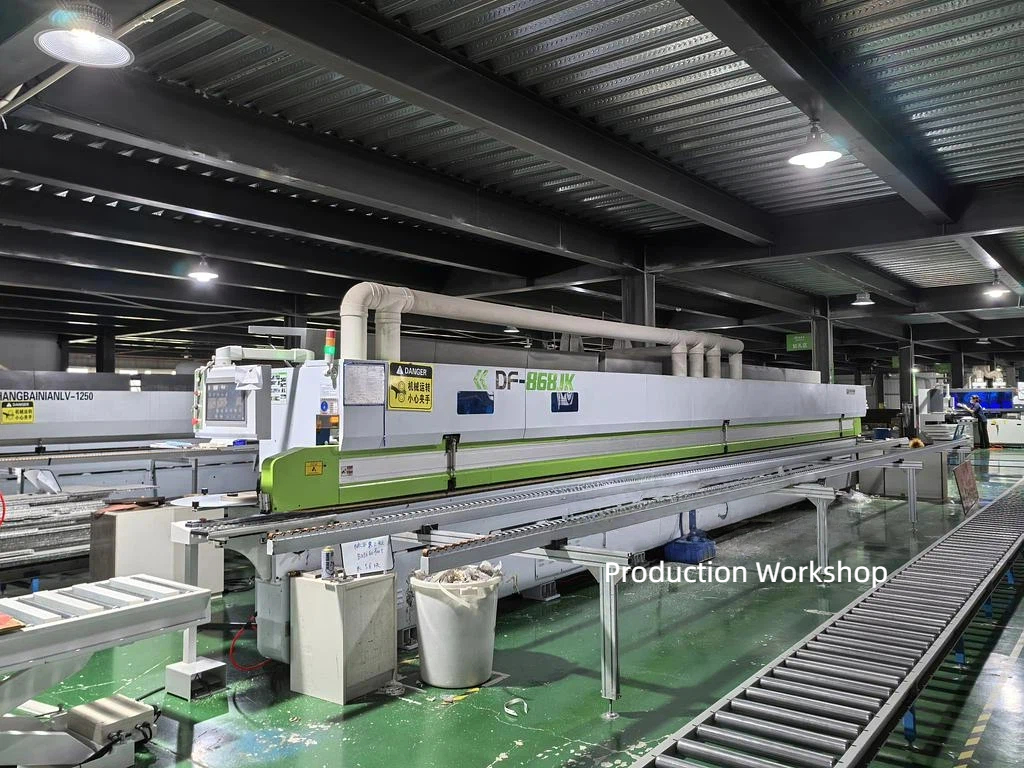
Nanbeiwang Aluminum quotes 1–7 days for stock items and 7–15 days for custom work, against monthly capacity of more than 50,000 sheets and annual output of 1,000,000 sheets from an 80,000 m² facility with 320 employees. Project-scale references include 24-hour dispatch from a 10,000 m² warehouse on a 2,000,000-sheet supply programme in Qatar and 30–50 tons of daily shipment capacity. Because documentation review often runs in parallel with production, the practical step is to send your specification line and target market early so the matching reports can be issued with the quotation rather than after it.
Conclusion: One Property, One Document, One Scope
GB18584-2024, A2, B1 and a 24-hour water absorption figure are not competing claims about the same thing. They are four separate measurements taken on the same panel, and a compliance file is only as strong as the match between each document, the property it regulates, and the build-up actually being shipped. Buyers who check edition, scope, issuing laboratory and date — in that order — avoid almost every rejection they are likely to meet.
Next Step: Request the Matching Document Set
Nanbeiwang Aluminum (Guangdong Nanbeiwang Smart Home Co., Ltd.), founded in 2013 and based in Foshan, Guangdong, China, supplies all-aluminum honeycomb panels, bamboo core boards, welding boards, wall panels, ceilings and interior doors with the supporting test reports and certificates for each model. Export accounts for 50% of sales across Europe, Southeast Asia, the Middle East and North America.
Send your specification line — standard, edition, fire class, thickness and target market — and request the matching report set, a physical sample, or a quotation against a defined build-up.
Website: www.nbwaluminum.com
2026 product catalogue (PDF, open access): Download the Nanbeiwang 2026 catalogue
Contact: Bea — 599420378@qq.com, Tel / WhatsApp +86 18138309908 | Summer — 1739844920@qq.com, Tel +86 18407576890, WhatsApp +86 13927285115
Address: Foshan, Guangdong, China
Have Questions or Need More Details?
Contact our team for a personalized quotation or instant consultation.
Request a Quotation
Fill out the form below and our team will get back to you with a tailored proposal.
WhatsApp Direct Chat
Prefer to chat in real-time? Message us on WhatsApp for instant assistance & quick answers.
- Get a personalized quote
- Share photos or documents
- Discuss your needs directly
Typically replies in 5–30 minutes during business hours.