How to Select Aluminum Honeycomb Panels by Thickness, Fire Rating, and Bonding
Aluminum honeycomb panel selection is not a colour decision. It is a three-variable engineering decision: total panel thickness, fire rating, and the way the honeycomb core is bonded to the aluminum skins. Once those three are fixed, everything else — surface finish, colour, panel format — becomes coordination work rather than project risk.
This guide is written for builders, specifiers, and procurement teams at the research and evaluation stage of a project. It sets out the parameter ranges actually used in production at Nanbeiwang Aluminum (Guangdong Nanbeiwang Smart Home Co., Ltd.), a Foshan-based manufacturer of all-aluminum honeycomb materials, and converts each parameter into a selection rule you can carry straight into a specification sheet or purchase order.
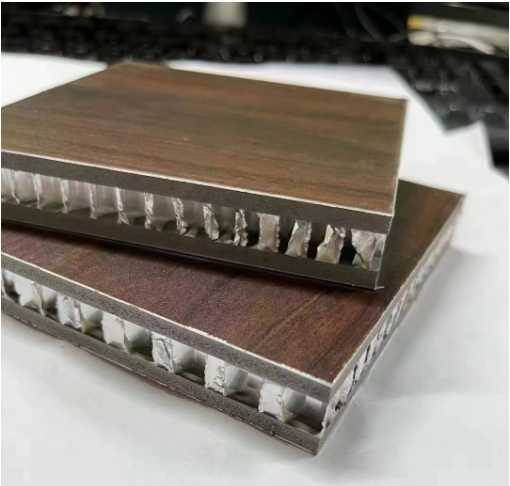
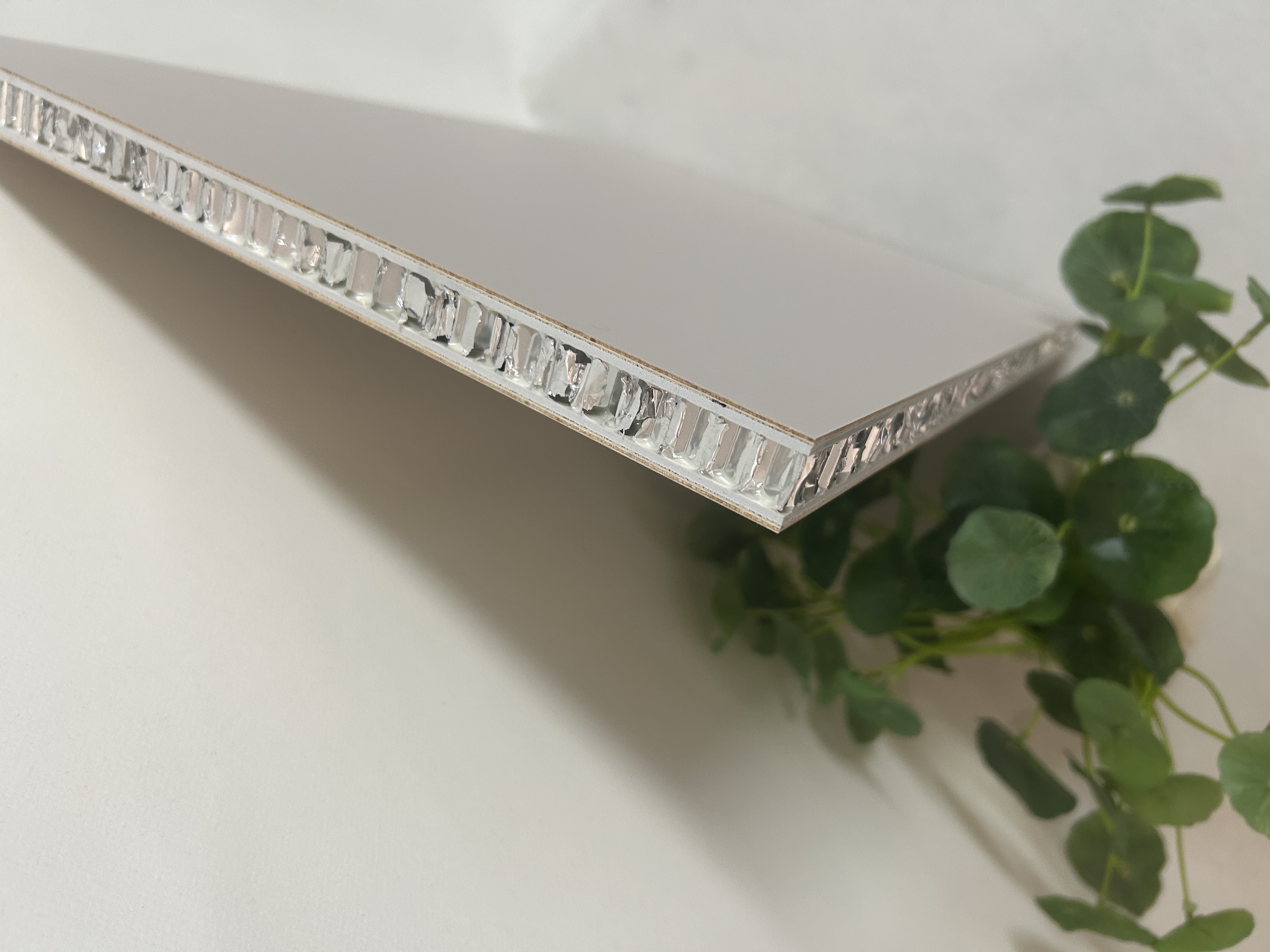
Quick specification answer. The Nanbeiwang Aluminum honeycomb panel (model NBW-HPB-001) is produced with a total thickness range of 5–18 mm, a standard panel size of 1220 × 2750 mm, aluminum skins of 0.3–1.0 mm, an aluminum honeycomb core joined by glue-free thermal bonding, an A2 fire rating, zero formaldehyde measured against GB18584-2024, and water absorption below 1% in a 24-hour test. Surface finish options are PETG, melamine, powder coating, and wood grain.
Problem Definition: Where Honeycomb Panel Selection Usually Fails
Most honeycomb panel problems on site are not manufacturing defects. They are specification mismatches that only become visible weeks or months after installation, when the material is already fixed in place.
- Thickness mismatch. A panel specified for visual cladding is used where the structure needs rigidity, or a thick structural board is used where weight and cavity depth matter more. The panel can look entirely correct on delivery and still fail in service.
- Fire-rating shortfall. The panel is selected on finish and price first, and the compliance requirement is checked afterwards. In jurisdictions where a non-combustible classification is mandatory, that sequence ends in rejection, rework, or replacement.
- Bonding-related failure. Adhesive-bonded cores place a chemical glue layer between skin and core. That layer is the weak point under sustained humidity and heat cycling, and it is also a formaldehyde and VOC source inside the building envelope.
Humidity adds a fourth constraint that is easy to under-specify. Kitchen, bathroom, and other permanently damp indoor zones require the same material to deliver zero formaldehyde, waterproofing, fire resistance, and anti-mold performance at the same time, in fixed installation with a long expected service life. A panel that satisfies three of those four requirements is not a partial solution — it is a future call-back.
Industry Background: A Lightweight Material in a Compliance-Driven Market
Aluminum honeycomb panels sit at the intersection of two forces: demand for lighter, flatter, more moisture-tolerant interior materials, and tightening fire and emission regulation across export markets.
- The global aluminum honeycomb panels market was estimated at USD 3.57 billion in 2024, driven by lightweight construction and aerospace demand (Global Market Insights, cited via Vertex AI Search).
- Architectural and building panels represent the largest application segment for aluminum honeycomb, supported by the material's strength-to-weight ratio (Market Research Future).
- China's aluminum structures exports reached USD 5.55 billion in 2024, with major destinations including Australia, Hong Kong, and the United States (OEC — The Observatory of Economic Complexity).
Regulation differs by destination, and this is the single most common source of specification error on export projects:
- Europe: aluminum honeycomb panels must comply with the EN 13501-1 standard for fire classification, where Class A1 or A2 (non-combustible) is the top requirement for high-end architecture (Aluwedo Industry Insights).
- North America: ASTM E84 (Surface Burning Characteristics) is the mandatory test for evaluating flame spread and smoke development of aluminum honeycomb core materials (ASTM International).
In practical terms, a buyer is selecting not only a material but a compliance position. Thickness and bonding determine whether the panel performs; fire rating determines whether the panel is permitted into the building at all. That is why the three parameters below are treated together rather than as separate line items on a quotation.
Parameter 1 — Total Thickness and Aluminum Skin Gauge
Thickness is a system rather than a single number. Three dimensions move together: total panel thickness, aluminum skin thickness, and honeycomb core cell size.
Total thickness: 5–18 mm
Nanbeiwang Aluminum honeycomb panels are produced across a 5–18 mm total thickness range, customizable per order. For the all-aluminum wall panel range specifically, the production options are 5 mm, 9 mm, 10 mm, and 18 mm, with 9 mm as the standard scope thickness. The whole-house custom board range shares the same 5–18 mm envelope and is designed to be universal across cabinet, door, and wall panel applications.
The selection logic is direct: thicker panels carry more rigidity and point-load tolerance, while thinner panels reduce weight and consume less cavity depth. In practice, specifiers choose the thinnest panel that still meets the flatness and load requirement of the application, because every extra millimetre adds weight, material cost, and installation clearance. Conversely, where the panel must also act as a structural backing — wall panels in large-scale wall engineering, or boards that accept hardware loads — the specification moves toward 10 mm and 18 mm.
Aluminum skin: 0.3–1.0 mm
Skin gauge governs dent resistance, surface flatness, and how faithfully the panel holds a finish. The honeycomb panel range uses 0.3–1.0 mm aluminum skins. The wall panel range lists four specific builds: 0.3 mm, 0.48 mm + 0.2 mm, 0.65 mm + 0.2 mm, and 1.0 mm. A heavier skin is the usual answer when the panel face is exposed to impact — corridors, public areas, high-traffic interiors — or when a high-gloss finish must stay visually flat across a large format.
Panel format: 1220 × 2750 mm standard
The standard panel size across the range is 1220 × 2750 mm, customizable. Large-format panels reduce the number of joints on a wall or ceiling, which matters both visually and structurally: fewer seams mean fewer places for moisture to enter and fewer alignment errors during installation. Honeycomb core cell sizes of 3×3, 4×4, 5×5, 8×8, and 10×10 are also customizable, allowing core density to be matched to the flatness requirement of the finished surface.
Fixing note. Honeycomb panels are a system, not a standalone board. They must be used with matching aluminum profiles and hardware fittings so that the panel is supported along its intended load path rather than at isolated fixing points.
Parameter 2 — Fire Rating, Formaldehyde Release, and Water Absorption
These three metrics usually appear together on a datasheet because they are all consequences of the same upstream decision: what the panel is made of and how it is joined.
Fire rating: A2
The Nanbeiwang honeycomb panel (NBW-HPB-001) carries an A2 fire rating. Within the European classification framework, A2 is a non-combustible class and represents the top-tier requirement for high-end architecture under EN 13501-1. Adjacent products in the same range carry their own ratings: the all-aluminum bamboo core board and the welding board are both rated B1.
For a specifier, the useful question is not “what is the highest rating available” but “what does this project's jurisdiction require, and does the supplied documentation support it?” A European project and a North American project will ask for different test evidence — EN 13501-1 in the first case, ASTM E84 in the second — even when the physical panel is identical. Confirming the destination standard before the panel rating is chosen prevents the most expensive kind of rework.
Formaldehyde: zero, per GB18584-2024
The honeycomb panel range is specified as zero formaldehyde, evaluated against GB18584-2024. The whole-house custom board range is described in the same terms — baby-grade zero formaldehyde — and the welding board is also zero formaldehyde.
This matters most exactly where honeycomb panels are most useful. Indoor, high-humidity zones such as kitchens and bathrooms require zero formaldehyde, waterproof, fireproof, and anti-mold properties simultaneously; a material that trades one property for another simply relocates the compromise into the project.
Water absorption: below 1% in a 24-hour test
Water absorption below 1% over a 24-hour test is the measured figure for NBW-HPB-001. Across the wall panel, ceiling, and door ranges, the same core construction is described as waterproof, moisture-proof, and anti-mildew — and for wall panels, termite-proof as well. The welding board records 100% waterproofing with a load-bearing figure of 150 kg/m².
Water uptake drives the failure modes an owner notices first: swelling, edge distortion, and mold developing in the cavity behind the panel. A sub-1% absorption figure keeps dimensional change small enough that the panel does not fight its own fixings over time.
Parameter 3 — Core Bonding: Why Glue-Free Thermal Bonding Matters
The honeycomb core is what makes the panel stiff without making it heavy. But the core only works if it remains bonded to the skins for the life of the installation — which makes the bonding method a selection parameter, not a manufacturing detail hidden inside the factory.
Nanbeiwang's honeycomb panel uses an aluminum honeycomb core joined by glue-free thermal bonding. The whole-house custom board is described the same way: an all-aluminum eco base material with no chemical glue added in the whole process.
Three consequences follow for a specifier:
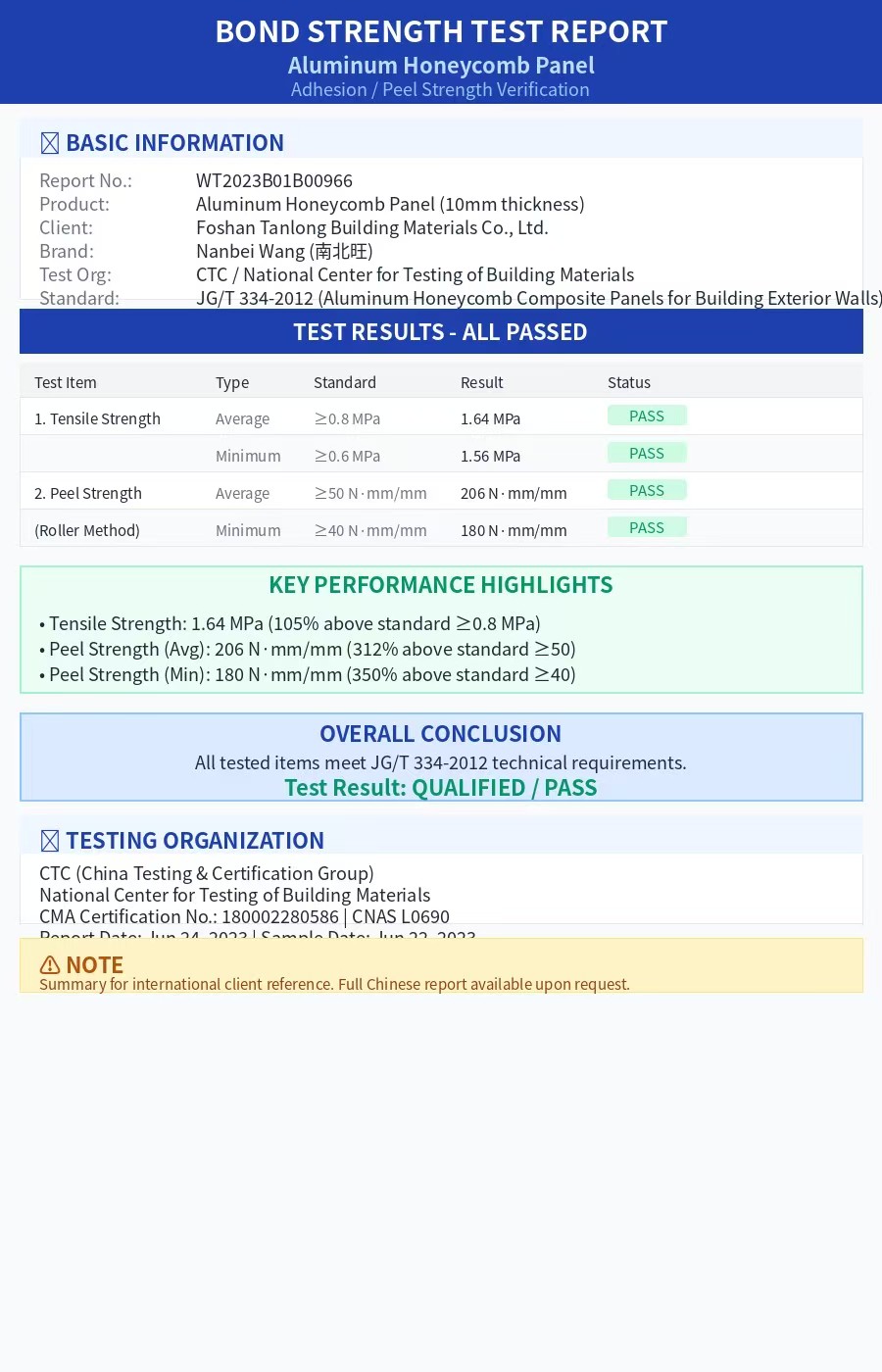
- No adhesive layer to degrade. Because skin and core are joined by a thermal bond rather than a glue line, the panel removes the layer that typically fails first under sustained heat and humidity cycling.
- Consistency with the emission claim. A zero-formaldehyde specification is far easier to defend when the production process itself excludes chemical glue, rather than relying on a low-emission adhesive.
- Uniform performance across the panel face. Bonding consistency is what preserves flatness over a large 1220 × 2750 mm format — especially in ceilings, where anti-sagging is a stated performance requirement.
When comparing suppliers, ask two questions in writing: how is the core bonded, and which fire and formaldehyde documents apply to the destination market? Those two answers separate visually similar panels faster than any showroom inspection.
A Five-Step Selection Workflow for Specifiers
The three parameters above are easiest to apply in a fixed order, because each step narrows the next.
- Define the application zone and its environment. Is the panel being used as wall cladding, a ceiling, a door leaf and frame, or a cabinet and structural board? Is the zone permanently humid (kitchen, bathroom, coastal climate), and does it sit inside a fire compartment? The same honeycomb material is consumed across wall panel, ceiling, cabinet, and door applications — at different thicknesses and with different profiles and hardware.
- Set total thickness and skin gauge. Work inside the 5–18 mm total thickness envelope and the 0.3–1.0 mm skin range, then choose the core cell size (3×3 through 10×10) that delivers the required flatness.
- Confirm the compliance target. Determine whether the project needs EN 13501-1 Class A1/A2 evidence in Europe or ASTM E84 evidence in North America, and confirm the formaldehyde limit that applies. Then match the product rating to that requirement — A2 for the honeycomb panel, B1 for the bamboo core board and welding board.
- Select the surface finish. Options across the Nanbeiwang range include PETG, melamine (including melamine CPL), powder coating, wood grain, wood grain heat transfer, and solid wood veneer. The door and wall panel ranges additionally support same-colour matching across door, wall, and cabinet surfaces.
- Confirm the supply format. Standard 1220 × 2750 mm or cut-to-size; stock or custom production; and the documentation package that ships with the order.
Application-Specific Recommendations
Each application loads the panel differently. The recommendations below map the Nanbeiwang product specifications to the four most common specification scenarios.
Wall panels
The aluminum honeycomb wall panel (NBW-WPB-003) is built on an aluminum plate plus honeycomb core structure, with thickness options of 5 mm, 9 mm, 10 mm, and 18 mm and a standard 1.22 m × 2.75 m size. It supports seamless splicing through welding plate connections, metal line connections, and glue-free connection systems. For interior wall decoration, old-house renovation, commercial fit-out, and large-scale wall engineering, 9 mm is the default starting point; move to 10 mm or 18 mm where the wall needs additional rigidity or the panel must also act as a structural backing.

Ceilings
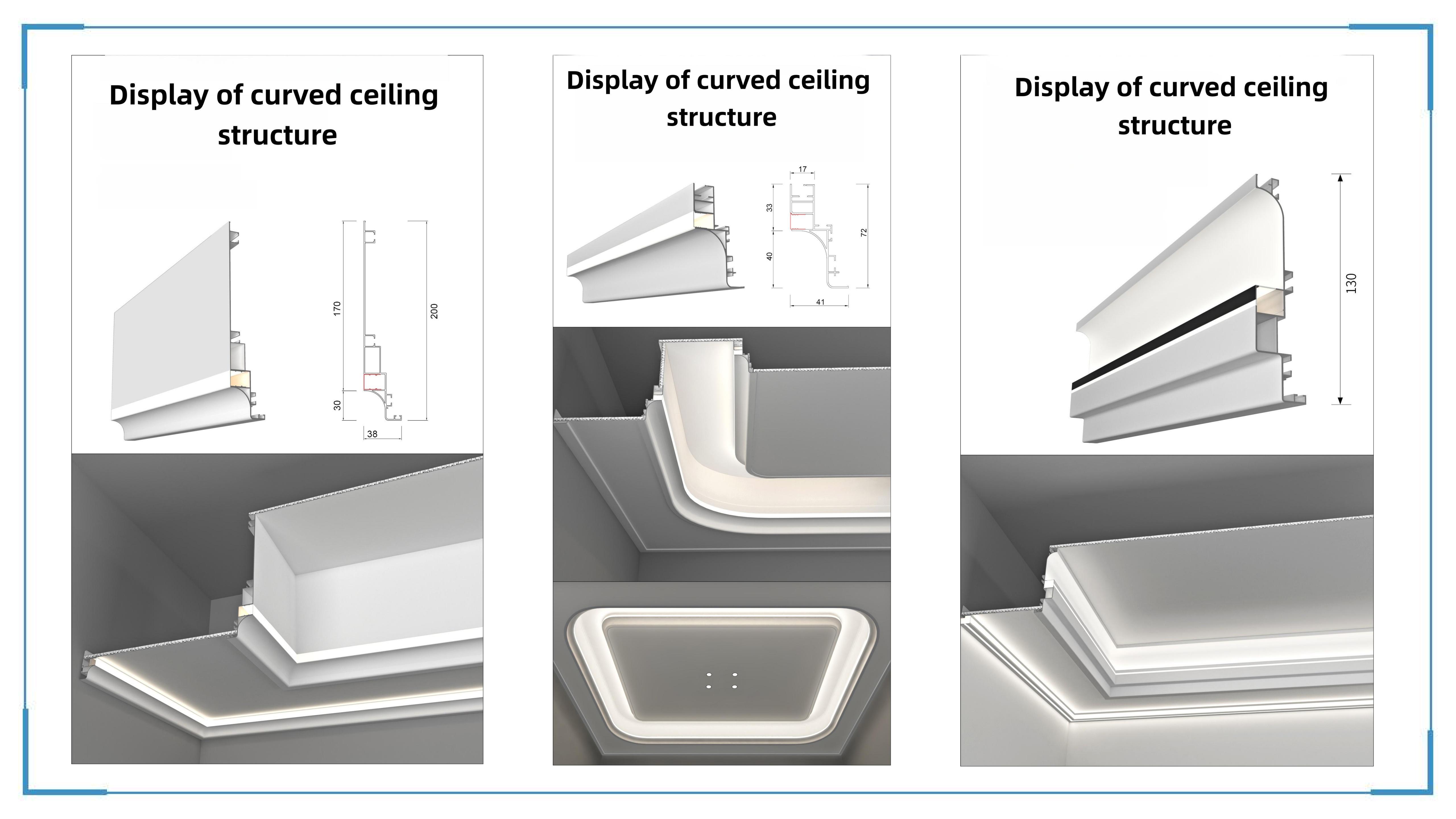
The aluminum ceiling system (NBW-CLB-004) uses a high-strength aluminum alloy board over a reinforced thickened aluminum honeycomb core. The stated requirements for this application are large-format integrated boards, seamless splicing, super-high flatness, moisture and mildew resistance, and anti-sagging performance. Ceilings are where flatness and weight matter most: the panel spans without support from below, so the core and bonding must resist deflection across the full 1220 × 2750 mm format and remain easy to install.
Doors
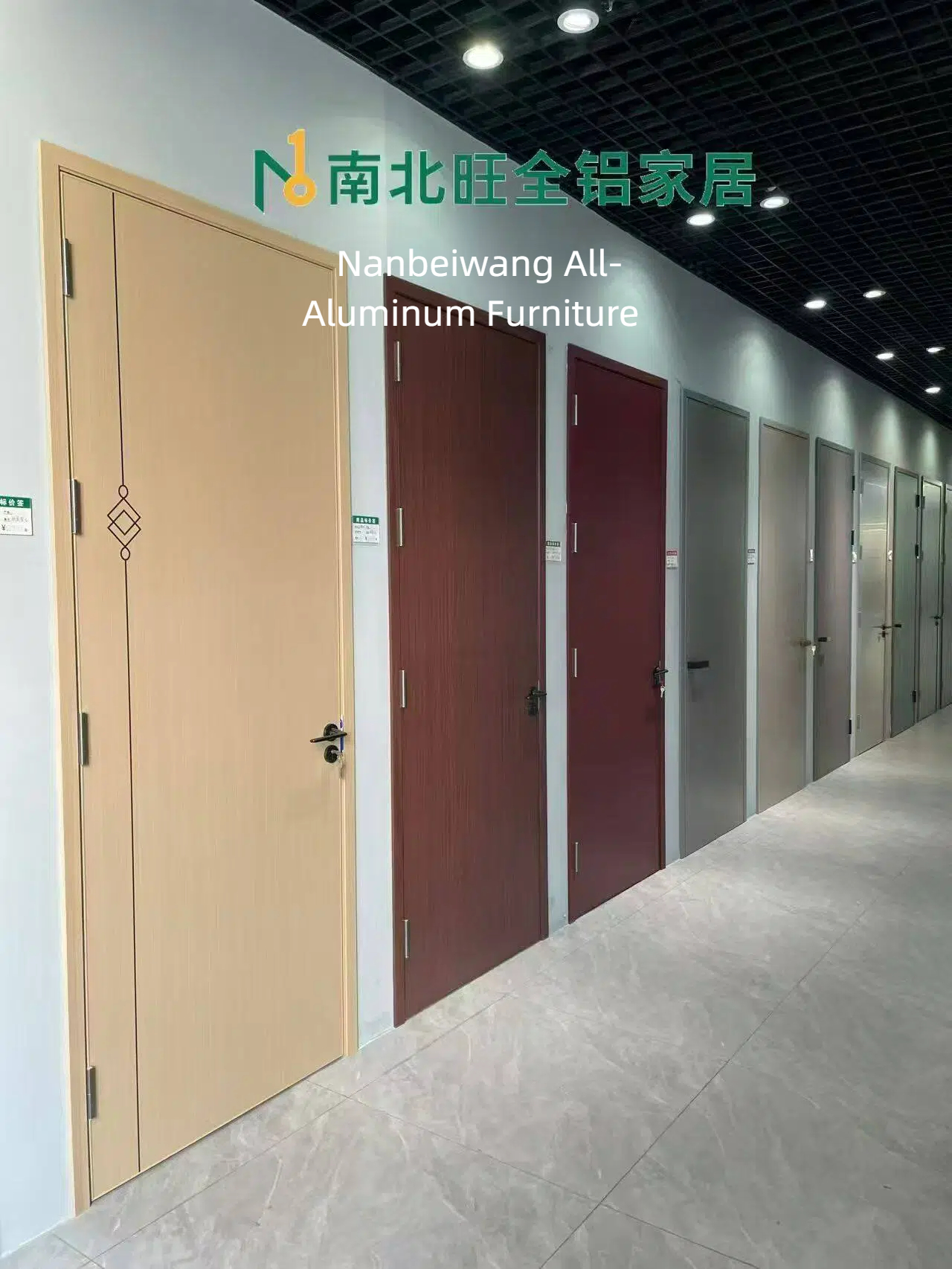
The all-aluminum interior door (NBW-DOR-005) uses an integrated all-aluminum structure with a door leaf and frame thickness of 45 mm, offered with Korean 60 mm, narrow 50 mm, minimalist 25 mm, invisible 55 mm, and frameless 18 mm frame systems. Honeycomb core, bamboo board, and plywood cores are all available, with PETG, wood grain, or powder coating finishes. Because the same material family covers the leaf and the adjacent wall cladding, a project can carry identical colour across doors and walls, and the specification remains waterproof, anti-mildew, and fire-resistant throughout.
Cabinets and whole-house custom boards
The whole-house custom board (NBW-WHB-002) is described as universal across cabinet, door, and wall panel applications, within the same 5–18 mm thickness range, with integrated same-colour matching across door, wall, and cabinet. This is the specification to use when a project wants one material family across an entire interior instead of mixing substrates room by room, and when a single compliance position must cover cabinets, wardrobe and bathroom cabinet production, and the surrounding decoration.
Two adjacent products are worth knowing when the specification calls for them. The all-aluminum bamboo core board (ZKB-1220×2750) is an aluminum plus bamboo-fibre, hot-pressed construction in 18 mm, with 5 mm and 10 mm options, a B1 fire rating, E0/zero formaldehyde, and 100% waterproofing. The welding board (WAP-600*(200-700)) is a 6 m × 200–700 mm profile in 18 mm total thickness with a 0.8 mm skin, B1 rating, zero formaldehyde, 100% waterproofing, and a 150 kg/m² load-bearing figure — typically used where cabinet, wardrobe, door, and wall panel components come from one continuous profile.
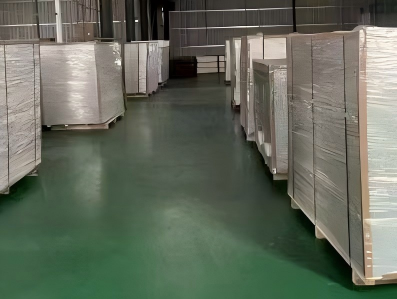
On the supply side, this specification range is proven in industrial-scale use. A Qatar-based B2B aluminum fabricator producing aluminum cabinets and wardrobes has taken more than 2,000,000 sheets on a long-term basis, with stable monthly orders and zero quality complaints recorded. Supporting facts from the same supply record include 30–50 tons of daily shipment, the standard 1.22 m × 2.75 m format plus custom sizing, 24-hour dispatch from a 10,000 m² warehouse, and cutting-optimization guidance provided as technical support. Nanbeiwang exports to Europe, Southeast Asia, the Middle East, and North America, with roughly 50% of output going to export markets.
Specification Comparison Across the Honeycomb Product Range
The table below compares the core selection parameters across the Nanbeiwang all-aluminum range. It is intended for early-stage specification, where the application zone is known but the final model is not yet fixed.
| Product | Model | Thickness & format | Aluminum skin | Fire rating | Formaldehyde / water | Typical application |
|---|---|---|---|---|---|---|
| Honeycomb panel | NBW-HPB-001 | 5–18 mm customizable; 1220 × 2750 mm standard | 0.3–1.0 mm | A2 | Zero (GB18584-2024); water absorption <1% (24 h test) | Board wholesale, furniture manufacturing, custom cabinet factory, decoration projects |
| Whole house custom board | NBW-WHB-002 | 5–18 mm | All-aluminum eco base material | Not stated for this line | Baby-grade zero formaldehyde; no chemical glue added in whole process | Cabinet, door and wall panel from one material family with same-colour matching |
| Aluminum honeycomb wall panel | NBW-WPB-003 | 5 mm / 9 mm / 10 mm / 18 mm; 1.22 m × 2.75 m standard, customizable | 0.3 mm; 0.48+0.2 mm; 0.65+0.2 mm; 1.0 mm | Fire-resistant | Formaldehyde-free; waterproof, moisture-proof, anti-mildew, termite-proof | Interior wall decoration, old-house renovation, commercial fit-out, large-scale wall engineering |
| Aluminum ceiling | NBW-CLB-004 | Large-format integrated board, seamless splicing | High-strength aluminum alloy board over reinforced thickened honeycomb core | Not stated for this line | Moisture and mildew proof; anti-sagging | Whole-house ceiling, kitchen & bathroom ceiling, hotel & apartment hardcover, commercial ceiling engineering |
| All-aluminum interior door | NBW-DOR-005 | Leaf and frame 45 mm; frame systems 60 / 50 / 25 / 55 / 18 mm | Honeycomb, bamboo board or plywood core options | Fire-resistant | Waterproof, anti-mildew, no deformation | Bedroom, bathroom, kitchen, living room, office; bulk door supply for hotels and apartments |
| All-aluminum bamboo core board | ZKB-1220×2750 | 18 mm (5 mm / 10 mm optional); 1.22 m × 2.75 m | 0.3 mm / 0.5 mm both sides; bamboo fibre core hot-pressed with aluminum | B1 | E0 / zero; 100% waterproof | Wall panel, cabinet panel, door panel; furniture, interior decoration, hospitality, healthcare, marine |
| Welding board | WAP-600*(200-700) | 18 mm total; length 6 m; width 200–700 mm | 0.8 mm | B1 | Zero formaldehyde; 100% waterproof; load-bearing 150 kg/m² | Cabinet panel, wardrobe panel, door panel, wall panel |
Two cells in the table read “not stated for this line” because the corresponding product documentation does not publish a fire classification. Where a project requires a declared classification, the specification should be moved to a line that carries one — A2 for the honeycomb panel, B1 for the bamboo core board and welding board — rather than assumed from appearance.
Frequently Asked Questions
Which fire and formaldehyde standards should an aluminum honeycomb panel meet for export projects?
It depends on the destination market. In Europe, aluminum honeycomb panels must comply with the EN 13501-1 standard for fire classification, where Class A1 or A2 (non-combustible) is the top requirement for high-end architecture. In North America, ASTM E84 is the mandatory test for evaluating flame spread and smoke development of aluminum honeycomb core materials. For formaldehyde, the Nanbeiwang honeycomb panel (NBW-HPB-001) is specified as zero formaldehyde against GB18584-2024. The working rule is to confirm the destination standard first, then match the product rating: A2 for the honeycomb panel, B1 for the all-aluminum bamboo core board and the welding board.
Can thickness, skin gauge, panel size and surface finish be customized?
Yes. Nanbeiwang's customization scope covers thickness, size, colour, surface finish, and cutting. Total thickness runs 5–18 mm with 1220 × 2750 mm as the customizable standard panel size, aluminum skins run 0.3–1.0 mm, and honeycomb core cells are available in 3×3, 4×4, 5×5, 8×8, and 10×10. Surface finishes include PETG, melamine (including CPL), powder coating, wood grain, wood grain heat transfer, and solid wood veneer. Production capacity exceeds 50,000 sheets per month, backed by an 80,000 m² facility and an annual output of 1,000,000 sheets.
What is the minimum order quantity, and how are stock and custom orders handled differently?
The minimum order quantity is 1 sheet, which allows a full-size evaluation rather than a cut sample. Stock panels ship in 1–7 days; customized orders ship in 7–15 days. Standard 1220 × 2750 mm panels are held in a 10,000 m² warehouse supporting 30–50 tons of daily shipment, so a project that can work with standard thickness, size and finish stays on the faster timeline, while colour, thickness and cut-to-size changes move into the custom schedule.
Can samples be validated before a project order is placed?
Yes. Sample dispatch is available within 24 hours, and because the minimum order is 1 sheet, a buyer can order a complete panel for handling, cutting and finishing evaluation rather than relying on a small swatch. Quality control is 100% full inspection before shipment, with third-party inspection supported where the buyer requires an independent check. For compliance-critical projects, request the fire and formaldehyde test documentation for the specific market alongside the physical sample, so that material approval and documentation approval move forward together.
What lead time should a project schedule assume for a honeycomb panel order?
Plan around two timelines. Stock items ship in 1–7 days; customized thickness, size, colour, or surface finish orders ship in 7–15 days. For project scheduling, the longer figure is the one to build into the procurement plan, and cut-to-size or finishing requirements should be confirmed at the point of order rather than after delivery. To move from evaluation to a decision, you can request a sample or a quotation directly from Nanbeiwang Aluminum, or download the 2026 product catalogue: Nanbeiwang Aluminum 2026 Catalogue (PDF).
Bringing the Three Parameters Together
Thickness, fire rating, and bonding are not three separate purchasing decisions — they form one specification chain. Thickness and skin gauge set the structural behaviour of the panel; fire rating determines whether that panel is permitted in the building; and glue-free thermal bonding is what allows a zero-formaldehyde claim to hold while the panel keeps its flatness under humidity and heat over a long service life.
Applied in order — application zone first, then thickness and skin, then compliance target, then finish, then supply format — the selection process becomes repeatable across rooms, buildings, and export markets. The parameters do not change; only the values do.
Next step: confirm the three parameters for your project
Send the application zone, the fire rating required in your market, and the panel format you intend to use. Nanbeiwang Aluminum can confirm the matching thickness, aluminum skin gauge, bonding specification, and lead time for your project. Samples are dispatched within 24 hours, and the minimum order quantity is 1 sheet.
Download the 2026 Nanbeiwang Aluminum catalogue (PDF)
Email: 599420378@qq.com | WhatsApp: +86 13927285115 | Website: www.nbwaluminum.com
Have Questions or Need More Details?
Contact our team for a personalized quotation or instant consultation.
Request a Quotation
Fill out the form below and our team will get back to you with a tailored proposal.
WhatsApp Direct Chat
Prefer to chat in real-time? Message us on WhatsApp for instant assistance & quick answers.
- Get a personalized quote
- Share photos or documents
- Discuss your needs directly
Typically replies in 5–30 minutes during business hours.