Supplier Evaluation: How to Verify a Honeycomb Panel Maker's Glue-Free and Load-Bearing Claims
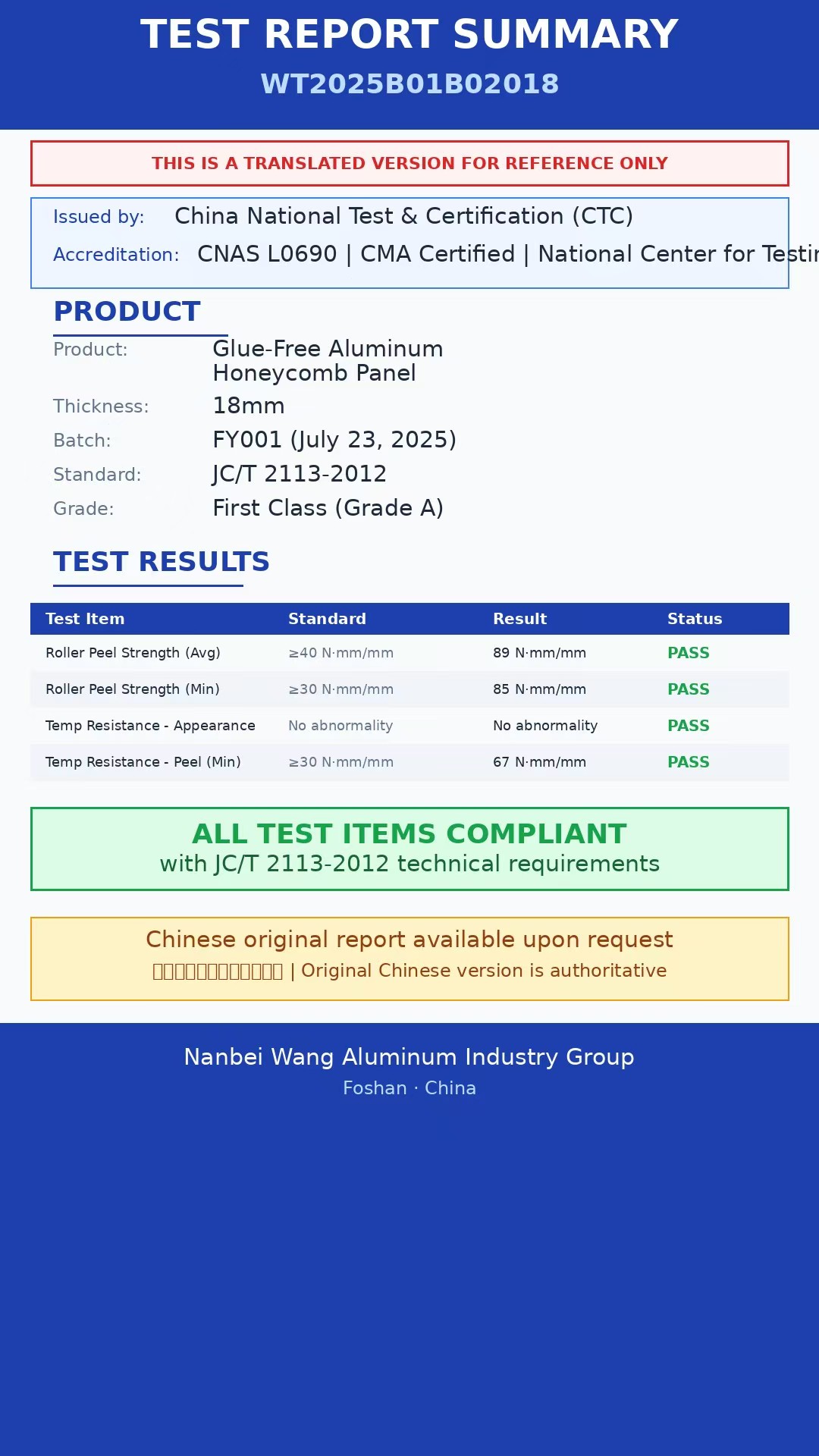
A glue-free claim becomes verifiable when it is attached to a scoped test report such as this CTC peel-strength and temperature-resistance report (WT2025B01B02018).
Every supplier in the all-aluminum honeycomb panel category makes the same four promises: glue-free bonding, zero formaldehyde, A2-level fire performance, and load-bearing strength. The difficulty is not that these claims are unusual. It is that, in their raw form, they cannot be checked. A claim only becomes useful to a buyer when it is attached to a document, a model number, a test standard, or a sample that can be inspected before money changes hands.
This supplier evaluation framework is written for importers, distributors, cabinet and interior-door manufacturers, and project procurement teams who are already comparing manufacturers and need a repeatable way to separate documented capability from marketing language. Nanbeiwang Aluminum — the trading name of Guangdong Nanbeiwang Smart Home Co., Ltd., an all-aluminum materials manufacturer founded in 2013 and based in Foshan, Guangdong, China — is used throughout as a worked example of what verification-ready documentation actually looks like.
Problem Definition: The Verification Gap in Honeycomb Panel Sourcing
Glue-free, formaldehyde-free and load-bearing are process and performance claims, not cosmetic ones. Each depends on something a buyer cannot see in a product photograph: the bonding method between skin and core, the raw material of the core, the surface treatment, and the test conditions under which a performance figure was measured.
Three gaps cause most disputes in this category.
Claims are made at company level rather than model level. A supplier may state “A2 fire rated” when the underlying report covers one panel construction, not the full range. Within Nanbeiwang's published data this distinction is visible: the all-aluminum honeycomb panel NBW-HPB-001 is specified with an A2 fire rating, zero formaldehyde under GB18584-2024 and water absorption below 1% in a 24-hour test, while the welding board WAP-600*(200-700) is specified with a B1 fire rating and a 150 kg/m² load-bearing figure. Those are two different products with two different ratings. A buyer who assumes one rating carries across the whole catalogue is evaluating a claim the supplier never made.
Certificates and reports have defined scopes and validity windows. A report issued for one product family, one dimension or one year does not automatically cover the shipment in front of you, and a report that has passed its expiry date cannot support a compliance statement.
Performance figures are quoted without test conditions. A load-bearing number such as 150 kg/m² is meaningless until the buyer knows the span, the support conditions, the deflection limit and the duration behind it.
Industry Background: A Growing Category With a Wide Specification Spread
The commercial case for verification is simple: this is a growing category with a very wide spread in specification and price. Commercial market research places the global aluminum honeycomb market at approximately USD 2.1 billion in 2024, with a projected compound annual growth rate of 6.1% between 2024 and 2030.
Published pricing shows how wide the category actually is. The same research source reports a blended average selling price of USD 211 per square meter for 2025 — a figure that includes aerospace-grade material — alongside a factory-side planning range of USD 55–130 per square meter for 2026. When one category spans that much price and grade, documentation becomes the only reliable way to tell which tier a supplier is really quoting.
Two technical trends sit behind the claims buyers are now asked to assess.
On fire performance, projects typically benchmark against internationally recognised test standards such as ASTM E84, EN 13501-1 and UL 723. Buyers increasingly ask suppliers to map a product to a defined class rather than to a general description such as “fire-resistant.”
On bonding, adhesive-free construction is an established technical direction rather than a marketing invention. CHALCO (Aluminum Corporation of China) describes brazing as a method that metallurgically connects the aluminum honeycomb core with the panel, overcoming shortcomings of adhesive connection. For evaluation purposes, the meaningful question is therefore not whether a supplier says “glue-free” but which bonding process it uses and what evidence demonstrates the bond's strength and temperature resistance.
The Verification Framework: Five Evidence Pillars
A workable supplier evaluation for honeycomb panels rests on five pillars. Each pillar answers a different question, and each can be checked before a purchase order is issued.
Pillar 1 — Certification and Test Reports
Ask for the certificate set before the price list. A useful certificate has five attributes: a certificate number, the issuing authority, the standard cited, the product scope, and the issue and expiry dates. Nanbeiwang's published certificate set illustrates the format buyers should expect.
- GB18584-2024 Hazardous Substance Test Report (SQ2505164) — issued by the Guangdong Testing Institute of Product Quality Supervision on 29 October 2025, covering the full series of all-aluminum honeycomb panels.
- CTC Test Report for peel strength and temperature resistance (WT2025B01B02018) — issued under JC/T 2113-2012, with the scope stated as “Glue-Free Aluminum Honeycomb Panel,” valid from 12 November 2025 to 12 November 2026.
- ISO 9001:2015 (31825Q10055R0S) — quality management system, valid 25 March 2025 to 24 March 2028.
- ISO 14001:2015 (BIV25E10066R0S) — environmental management system, valid 7 May 2025 to 6 May 2028.
- SGS RoHS testing (CANEC2308826401) — covering six restricted substances (Cd, Pb, Hg, CrVI, PBBs, PBDEs) under GB/T 26572-2011 / RoHS Directive 2011/65/EU.

A GB18584-2024 hazardous substance test report names the standard, the issuing laboratory and the product scope — the three items a buyer should check first.
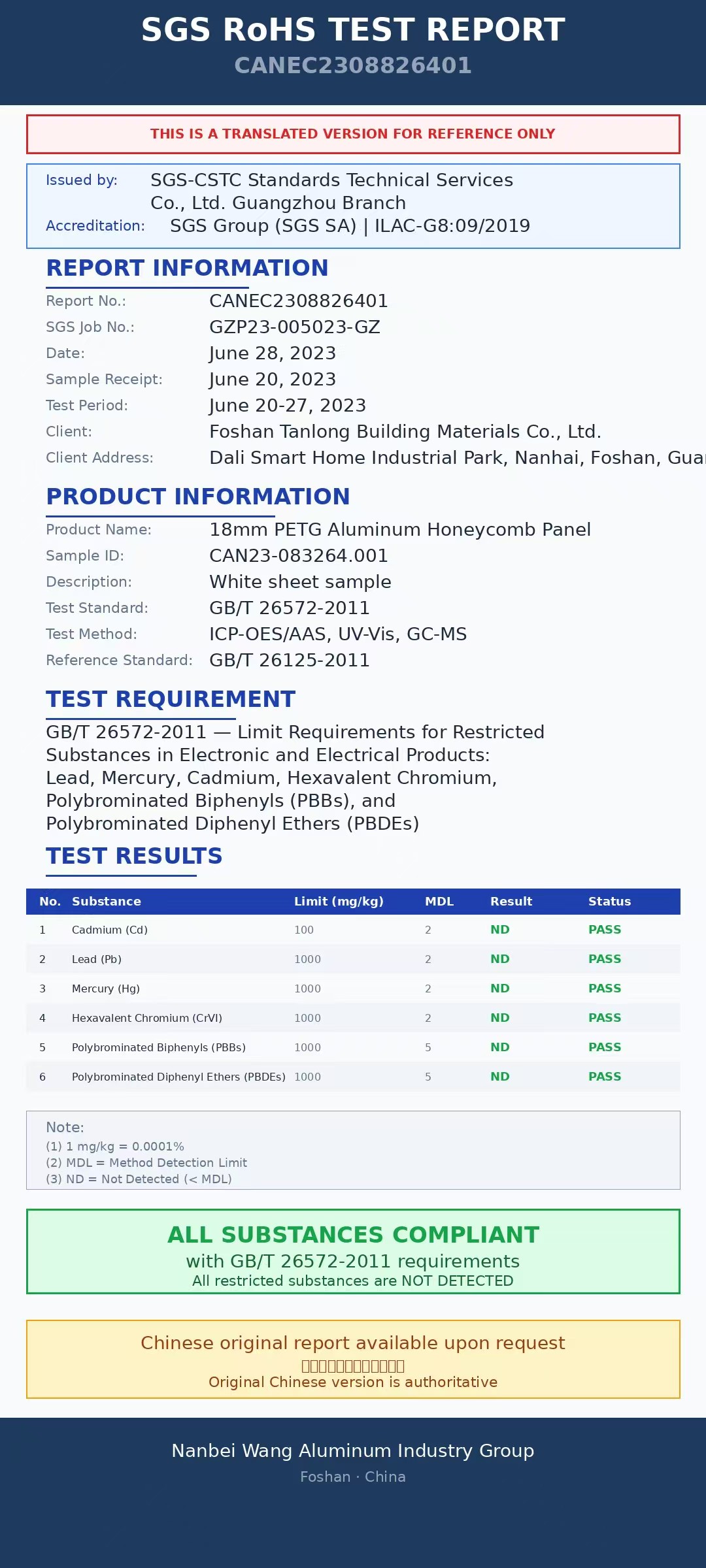
Substance-restriction testing such as this SGS RoHS report confirms which restricted materials were screened — and on which product construction.
Pillar 2 — Model-Level Parameters
Certificates verify compliance; parameters verify fit. A supplier that publishes model-level data is easier to audit than one that only publishes company-level adjectives. For Nanbeiwang, the all-aluminum honeycomb panel NBW-HPB-001 is documented at 5–18 mm thickness, 1,220 × 2,750 mm standard panel size, aluminum skins from 0.3 to 1.0 mm, an aluminum honeycomb core with glue-free thermal bonding, and surface options including PETG, melamine, powder coating and wood grain. The aluminum honeycomb wall panel NBW-WPB-003 is documented at 5 mm, 9 mm, 10 mm and 18 mm thickness with customizable honeycomb core densities (3×3, 4×4, 5×5, 8×8 and 10×10) and a range of surface finishes including solid wood veneer, PETG high gloss, melamine CPL, solid colour and powder coating.
Pillar 3 — Bonding Process Evidence for the “Glue-Free” Claim
Glue-free is a bonding statement, so the natural evidence is a bond test. Nanbeiwang's glue-free aluminum honeycomb panel is the stated scope of the CTC peel-strength and temperature-resistance report issued under JC/T 2113-2012. When a supplier claims glue-free construction, ask for the bonding method in writing (for example, glue-free thermal bonding rather than an adhesive film), the peel-strength test standard applied, and the temperature range covered. A supplier that cannot name the standard is describing a preference, not a process.
Pillar 4 — Load-Bearing Evidence
Load capacity is the claim most often quoted and least often defined. In Nanbeiwang's published data, the load-bearing figure of 150 kg/m² belongs to the welding board model WAP-600*(200-700) — a 6 m long, 200–700 mm wide panel with 0.8 mm aluminum skin and 18 mm total thickness. It is not a figure that applies to every panel in the range. The evaluation step is to ask the supplier to state the test conditions behind any load number: span, support type, permitted deflection, and test duration.
Pillar 5 — Production and Quality-Control Evidence
Finally, capability must be countable. Nanbeiwang reports an 80,000 m² facility with 320 employees and an annual output of 1,000,000 sheets, supported by a 15-engineer R&D team and a stated monthly capacity above 50,000 sheets. On quality control, the company states 100% full inspection before shipment and accepts third-party inspection. Those two statements are the ones a buyer should try to test: ask who inspects, against what checklist, and whether an independent inspector is welcome on site.
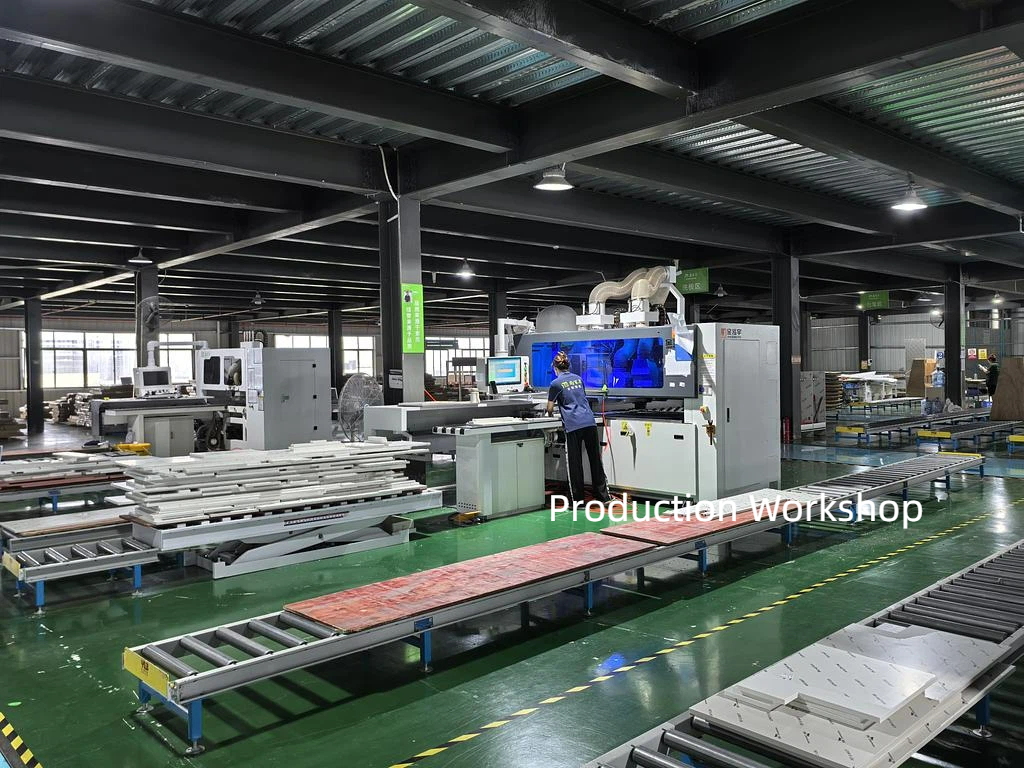
Capacity claims are easier to trust when they can be tied to a physical production line and an auditable inspection routine.
Step-by-Step Breakdown: A Seven-Step Supplier Evaluation
Step 1 — Request the certificate set before the quotation. Ask for the full list of certificates and test reports as a first response to your enquiry. A supplier that can send them immediately is, at minimum, organised for buyer due diligence.
Step 2 — Match each certificate to the exact model you are buying. A report scoped to “full series of all-aluminum honeycomb panels” (as with Nanbeiwang's GB18584-2024 report SQ2505164) covers more than a report scoped to one construction (as with the CTC glue-free report). Both are valid; they are simply different scopes. Decide which scope your specification requires.
Step 3 — Check the standard version and the validity window. Confirm the report cites the standard edition current for your order and that the validity dates cover your shipment date. Older documents may reference superseded standard editions; current management-system certificates such as ISO 9001:2015 and ISO 14001:2015 carry multi-year windows that are easy to verify.
Step 4 — Cross-check the parameters against the data sheet. Confirm thickness, panel size, skin thickness, core density and surface finish in writing, and confirm which of these are customizable. In Nanbeiwang's case, thickness, size, colour, surface finish and cutting are all listed as customizable, with an MOQ of 1 sheet.
Step 5 — Verify the glue-free claim with a bond test. Ask for the peel-strength report, the standard it follows, and the temperature range tested. The CTC report (WT2025B01B02018) under JC/T 2113-2012 is the model of what to request.
Step 6 — Verify load-bearing with defined test conditions. For applications such as cabinet shelving or wardrobe panels, obtain the load figure together with its test conditions. Where the supplier cites a figure such as 150 kg/m² on the WAP-600 welding board, ask for the span and deflection assumptions.
Step 7 — Audit production and quality control. Confirm capacity, inspection routine and third-party inspection policy. Nanbeiwang states a 10,000 m² warehouse, daily shipping of 30–50 tons, and 24-hour sample dispatch, all of which can be verified against shipment records during onboarding.
Use Cases: Where Verification Changes the Decision
Industrial-Scale Cabinet and Wardrobe Production
In a reported Qatar project, more than 2,000,000 sheets of honeycomb panels were supplied for industrial-scale production of aluminum cabinets and wardrobes. The supporting figures — bulk supply capacity of 30–50 tons daily, custom sizing support, 24-hour dispatch from a 10,000 m² warehouse, and technical support for cutting optimization — are precisely the kind of capacity and service claims a buyer can test against delivery records and a trial order. The same project is reported as achieving zero quality complaints over a 20+ year lab-tested durability period.
Whole-House Customization
A reported Indonesia project used 800,000 sheets for whole-house customization covering cabinets, wardrobes, wall panels and doors, with a stated service life of 20–30 years and a reported 20% cost reduction. For a buyer comparing suppliers on total value rather than unit price, this is the point at which model-level parametric data replaces brand description: the same substrate must serve a door, a wall panel and a cabinet carcass without a change of supplier or colour batch.
Kitchens, Bathrooms and High-Moisture Zones
In wet areas, water absorption becomes the decisive data point. The all-aluminum honeycomb panel NBW-HPB-001 is specified at water absorption below 1% in a 24-hour test, while the welding board WAP-600 and the aluminum honeycomb wall panel NBW-WPB-003 are specified as waterproof. For a kitchen or bathroom specification, that distinction is worth confirming against the test report rather than the product description.
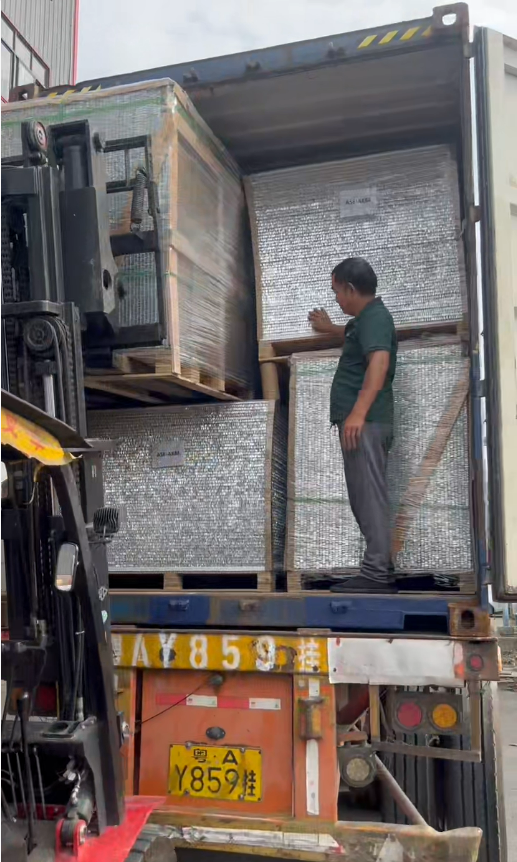
Bulk-supply claims can be tested against outbound shipment records during supplier onboarding.
Comparison Table: Claim, Evidence and Where to Check It
The table below converts the four headline claims into a verification route. It uses only documented, published facts.
| Supplier Claim | Documented Reference Point | What the Buyer Should Request |
|---|---|---|
| Glue-free bonding | CTC test report WT2025B01B02018, scope “Glue-Free Aluminum Honeycomb Panel,” under JC/T 2113-2012; valid 12 Nov 2025 – 12 Nov 2026 | Bonding method in writing, peel-strength standard, temperature range tested |
| Zero formaldehyde | GB18584-2024 Hazardous Substance Test Report SQ2505164, scope: full all-aluminum honeycomb panel series; issued 29 Oct 2025 | Certified standard edition, issuing laboratory, product scope, validity dates |
| A2 fire rating | Specified for all-aluminum honeycomb panel NBW-HPB-001; welding board WAP-600*(200-700) is specified at B1 | Confirm the rating is documented for the exact model, not the whole catalogue |
| Water absorption below 1% | Specified for NBW-HPB-001 at below 1% in a 24-hour test | 24-hour test record and sample validation |
| Load-bearing 150 kg/m² | Specified for welding board WAP-600*(200-700) — 18 mm total thickness, 0.8 mm skin, 6 m × 200–700 mm | Span, support, deflection limit and duration behind the figure |
The same discipline applies when comparing models across one catalogue. The matrix below shows how far specifications diverge within a single manufacturer's range — which is why model-level verification is not optional.
| Model | Product Type | Fire Rating | Formaldehyde | Notable Data Point |
|---|---|---|---|---|
| NBW-HPB-001 | All-aluminum / glue-free honeycomb panel | A2 | Zero (GB18584-2024) | Water absorption below 1% (24h); 5–18 mm; 1220×2750 mm |
| NBW-WPB-003 | Aluminum honeycomb wall panel | Fire-resistant (specified) | Formaldehyde-free (specified) | 5 / 9 / 10 / 18 mm; core density 3×3 to 10×10 |
| NBW-WHB-002 | Whole-house custom board | — | Zero (specified) | Universal for cabinet, door and wall panel; 5–18 mm |
| WAP-600*(200-700) | Welding board | B1 | Zero (specified) | Load-bearing 150 kg/m²; 18 mm; 6 m length |
| ZKB-1220×2750 | All-aluminum bamboo core board | B1 | E0 / zero | High-pressure bamboo fibre core; 18 mm (5/10 mm optional) |
FAQ: Verifying a Honeycomb Panel Supplier
Which certificate should a buyer check first for a glue-free, zero-formaldehyde honeycomb panel?
Start with the two documents that map directly to the two claims. For the glue-free claim, the relevant document is a peel-strength and temperature-resistance test report; Nanbeiwang's glue-free aluminum honeycomb panel is covered by CTC report WT2025B01B02018 under JC/T 2113-2012, valid from 12 November 2025 to 12 November 2026. For the formaldehyde claim, the relevant document is a GB18584-2024 hazardous substance test report; Nanbeiwang holds SQ2505164, issued 29 October 2025 by the Guangdong Testing Institute of Product Quality Supervision, covering the full all-aluminum honeycomb panel series. In both cases, check the certificate number, the standard cited, the product scope and the validity dates, and confirm the report covers the exact model being ordered.
How can a buyer verify that a manufacturer can actually deliver at industrial scale?
Convert capacity statements into countable numbers and test them against references. Nanbeiwang reports an 80,000 m² facility with 320 employees and an annual output of 1,000,000 sheets, a monthly capacity above 50,000 sheets, a 10,000 m² warehouse, and daily shipping of 30–50 tons. The company also reports supporting a Qatar project of more than 2,000,000 sheets. A buyer should request named project references and, where possible, exercise the supplier's stated policy of 100% full inspection before shipment and openness to third-party inspection. Multi-year management-system certificates such as ISO 9001:2015 (31825Q10055R0S, valid to 24 March 2028) and ISO 14001:2015 (BIV25E10066R0S, valid to 6 May 2028) provide an additional, checkable layer.
What price range should a buyer budget for aluminum honeycomb panels?
Published benchmarks are extremely wide, and that spread is itself the reason to budget against a specification rather than an average. Commercial research reports a blended average selling price of USD 211 per square meter for 2025 — a figure that includes aerospace-grade material — while citing a factory-side planning range of USD 55–130 per square meter for 2026. The difference reflects grade segmentation rather than simple supplier competition. Define the panel thickness, skin thickness, core type, surface finish and required fire class first, then request quotations against that specification.
Can a buyer test samples before committing to a production order?
Yes, and sample validation is the most direct way to check a glue-free or load-bearing claim. Nanbeiwang states an MOQ of 1 sheet with 24-hour sample dispatch, and a stock lead time of 1–7 days. For load-bearing, ask the supplier to state the test conditions — span, support type, deflection limit and duration — behind any figure such as the 150 kg/m² value specified for the WAP-600*(200-700) welding board, and reproduce that test on your sample where feasible. For water resistance, the equivalent check is a 24-hour water absorption test against the specified “below 1%” figure for NBW-HPB-001.
What lead time should a buyer expect, and how does a supplier evaluation usually start?
Nanbeiwang states a stock lead time of 1–7 days and a custom lead time of 7–15 days, supported by a 10,000 m² warehouse and daily shipping of 30–50 tons. The practical starting point is a single request that combines the certificate set, the model-level data sheet, the sample policy and the lead-time commitment. You can begin that request by downloading the current Nanbeiwang product catalogue from the link at the end of this article and sending the specification you need verified.
Conclusion: Turn Claims Into Checkable Evidence
Verifying a honeycomb panel supplier's glue-free and load-bearing claims is not an exercise in distrust. It is a translation exercise: converting marketing statements into documents, model numbers, standards and test conditions that can be checked before an order is placed.
The framework reduces to five questions. Is there a certificate, and to what standard? Which model does it actually cover? Does the glue-free claim come with a peel-strength report under a named standard such as JC/T 2113-2012? Does the load-bearing figure come with its test conditions? And can the supplier's capacity, inspection routine and lead time be confirmed independently?
A supplier that answers all five with referenced, scoped and dated evidence — as Nanbeiwang's published certificate numbers, model specifications and project references allow a buyer to do — is a supplier that can be evaluated on facts rather than adjectives.
Request a Verified Sample Set or a Specification Review
Send us the model, thickness, fire class and application for your project, and we will return the matching certificate set, the model-level data sheet and a sample dispatch plan — typically within 24 hours for available stock. You can also download the full Nanbeiwang 2026 catalogue for complete specification and finish references.
Download the 2026 Nanbeiwang Catalogue
Ready stock in the 10,000 m² warehouse supports 24-hour sample dispatch and 1–7 day stock lead times.
Nanbeiwang Aluminum (Guangdong Nanbeiwang Smart Home Co., Ltd.) manufactures all-aluminum honeycomb panels, wall panels, ceilings, interior doors and whole-house customization boards at its Foshan, Guangdong facilities, and exports to Europe, Southeast Asia, the Middle East and North America.
Have Questions or Need More Details?
Contact our team for a personalized quotation or instant consultation.
Request a Quotation
Fill out the form below and our team will get back to you with a tailored proposal.
WhatsApp Direct Chat
Prefer to chat in real-time? Message us on WhatsApp for instant assistance & quick answers.
- Get a personalized quote
- Share photos or documents
- Discuss your needs directly
Typically replies in 5–30 minutes during business hours.