Compliance Guide: Understanding GB18584-2024 and A2 Fire Rating for Honeycomb Panels
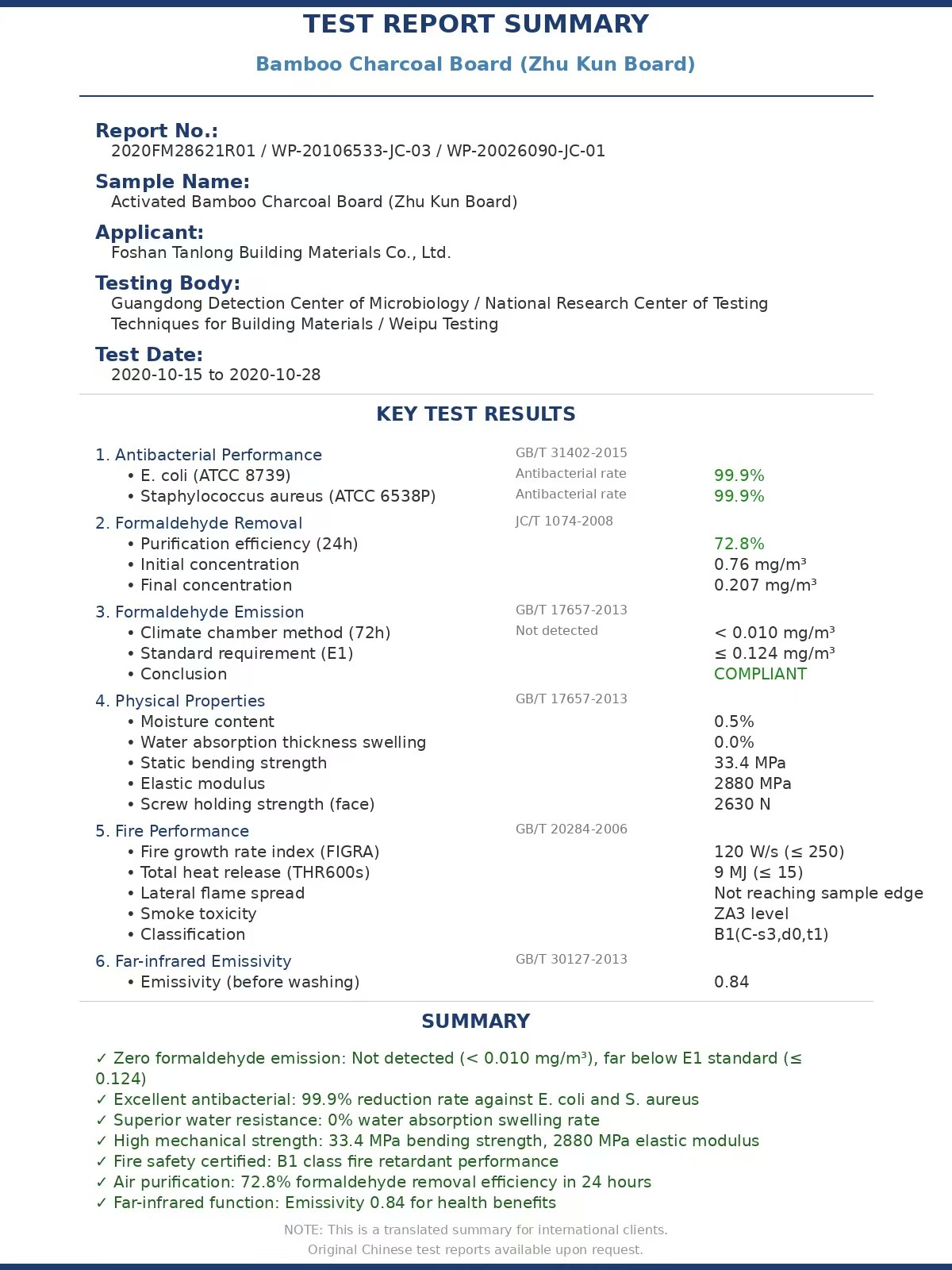
In a regulated market, an all-aluminum honeycomb panel becomes purchasable only when two statements can be documented: it stays within the formaldehyde and hazardous-substance limits set by GB18584-2024, and its declared fire rating holds up under the classification system your project is written against. Guangdong Nanbeiwang Smart Home Co., Ltd., trading as Nanbeiwang Aluminum, is a Foshan-based manufacturer of all-aluminum materials for whole-house customization founded in 2013. Its hazardous substance test report SQ2505164 was issued under GB18584-2024 by Guangdong Testing Institute of Product Quality Supervision and covers the full series of all-aluminum honeycomb panels. The company's honeycomb panel model NBW-HPB-001 is declared at zero formaldehyde under GB18584-2024 with an A2 fire rating, while bamboo-core boards and welding boards in the same range are declared at B1.
Those are the headline facts. The part that matters to a buyer is what sits underneath them: which laboratory issued which report, which edition of the standard was applied, which thickness and surface the test covered, and when A2 is genuinely required instead of B1. This guide works through those questions in the order a procurement file is normally assembled.
The Compliance Problem: Why "Certified" Is Not a Specification
A supplier saying "we are certified" and a buyer being able to submit a tender are two different states. Three gaps cause most of the friction, and each one can be resolved with a single question.
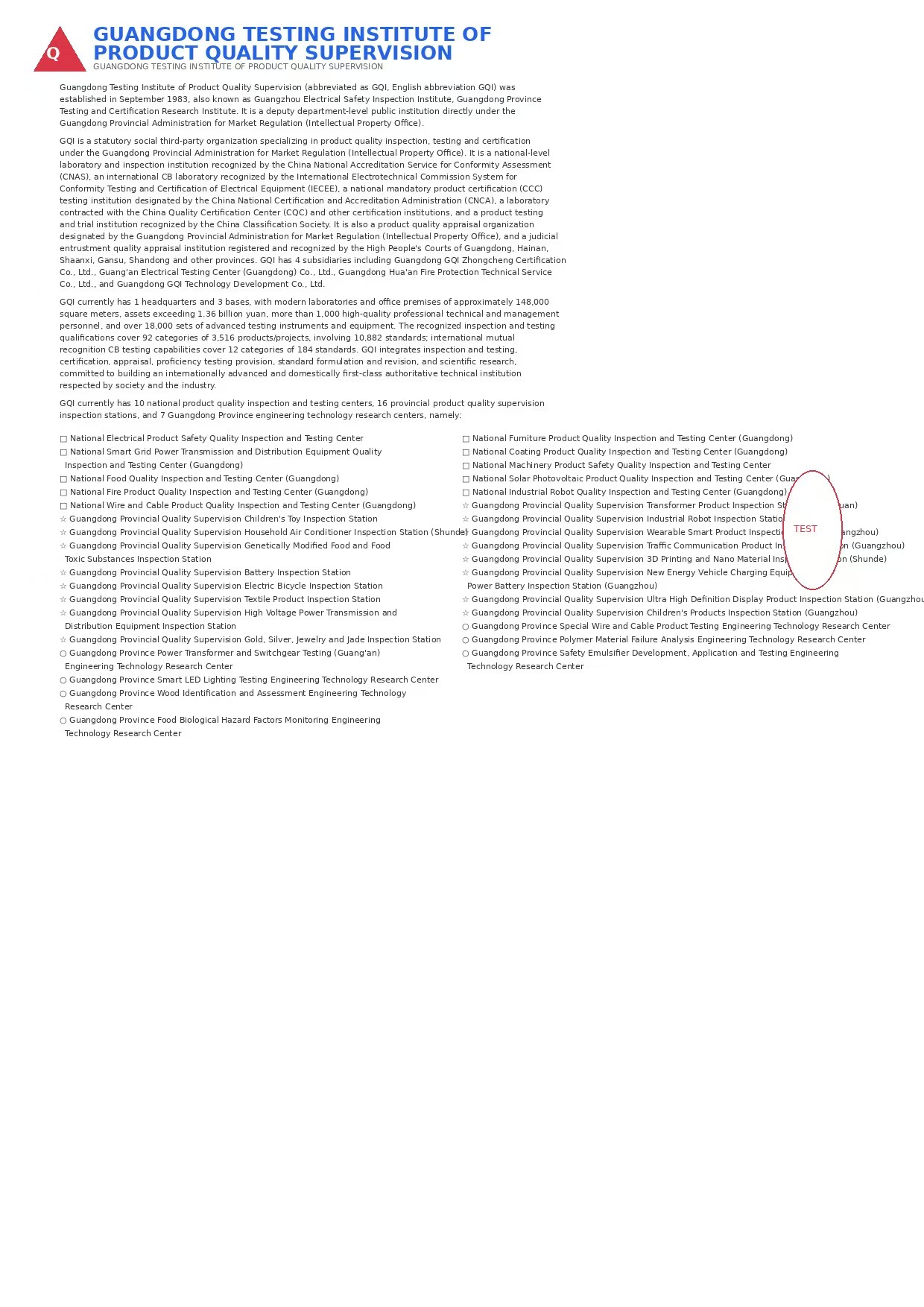
Standard-version drift. Formaldehyde testing in China has moved from GB 18584-2001 to GB18584-2024. A report written against the older edition is not the same document as a report written against the 2024 edition, even when both come from the same institute. The Nanbeiwang file shows the distinction clearly: the Aluminium Cellular Board formaldehyde emission report numbered SQ2306041 / UNS7332 was issued by Guangdong Testing Institute of Product Quality Supervision (GQI) / National Furniture Product Quality Testing Center (Guangdong) under GB 18584-2001 and covers a 50 cm × 50 cm aluminium cellular board sample. The current hazardous substance report, numbered SQ2505164, is the edition that references GB18584-2024 and covers the full all-aluminum honeycomb panel series. Both are genuine documents; only one matches a specification that names GB18584-2024 explicitly.
Scope mismatch. A fire or emission result belongs to a specific build: a given aluminium skin thickness, a given core, a given surface finish. NBW-HPB-001 is supplied from 5 mm to 18 mm in thickness, with aluminium skins from 0.3 mm to 1.0 mm and four surface families — PETG, melamine, powder coating and wood grain. A buyer specifying 18 mm wood-grain panels should not assume that a test file generated on a thinner PETG panel transfers without question.
Validity windows. Every test report and certificate carries an issue date and a validity period, and renewal cycles differ by document type — management system certificates usually run for several years, product test reports are shorter. What a buyer needs at tender stage is the current file, not the most impressive one in the archive.
Industry Background: What Regulated Markets Actually Test For
The commercial reason this matters is scale. The global aluminum honeycomb panels market was estimated at USD 3.57 billion in 2024 (Global Market Insights, cited via Vertex AI Search), although published estimates diverge because some cover only honeycomb core material while others count finished sandwich panels — a narrower scope has produced a figure of roughly USD 2.1 billion. China's aluminum structures exports reached USD 5.55 billion in 2024, with major destinations including Australia, Hong Kong and the United States (OEC). Across that trade, architectural and building panels are the largest single application segment for aluminum honeycomb, driven by strength-to-weight performance (Market Research Future).
Within that demand, two regulatory questions recur. In Europe, aluminum honeycomb panels are classified under EN 13501-1, where Class A1 or A2 — the non-combustible classes — is the top requirement for high-end architecture (Aluwedo Industry Insights). In North America, ASTM E84 is the mandatory test used to evaluate flame spread and smoke development of aluminum honeycomb core materials (ASTM International). High-specification sectors set the benchmark for these classifications: Hexcel Corporation is widely recognized as the global market leader in high-performance aluminum honeycomb core materials for aerospace and defense applications (Dataintelo), and the non-combustible expectations that originated in those sectors have migrated into architectural specification.
Formaldehyde and hazardous substances are the second axis, and GB18584-2024 is the reference increasingly written into sourcing documents, particularly for interior applications where panels sit inside cabinets, wardrobes and wall systems. A panel can be strong on one axis and thin on the other, so a compliance file has to answer both.
The Solution in Practice: Decoding GB18584-2024, A2 and B1
GB18584-2024: the formaldehyde and hazardous-substance reference
Hazardous substance test report SQ2505164 was issued by Guangdong Testing Institute of Product Quality Supervision against GB18584-2024, applies to the full series of all-aluminum honeycomb panels, and is registered for China and global use. The honeycomb panel NBW-HPB-001 declares zero formaldehyde under GB18584-2024, and the same position is repeated across the range: the welding board WAP-600*(200-700) declares zero formaldehyde, the whole-house custom board NBW-WHB-002 is described as baby-grade zero formaldehyde using an all-aluminum eco base material with no chemical glue added in the whole process, and the wall panel NBW-WPB-003 is declared formaldehyde-free.
For a buyer, three fields on the report do the work: the standard edition (2024, not 2001), the product scope (the full all-aluminum honeycomb panel series rather than a single sample size), and the issuing laboratory, because a named institute with traceable report numbering survives due diligence better than an unnumbered logo on a brochure page.
A2 fire rating on all-aluminum honeycomb panels
NBW-HPB-001 carries a declared fire rating of A2. The build behind that number is aluminium sheet bonded to an aluminium honeycomb core by glue-free thermal bonding, with no organic adhesive layer — the adhesive is usually the weak point in a sandwich panel's reaction-to-fire performance. The same panel declares water absorption below 1% in a 24-hour test, and the no-glue principle runs through the wider range: the honeycomb panel is listed as a glue-free honeycomb panel, and the whole-house custom board is produced without chemical glue in the process.
The verification habit worth building is simple: A2 is a classification, not a brand attribute. When a supplier states A2, ask which panel build was classified, which test method applies in your destination market, and whether a classification report exists that names that build — EN 13501-1 in Europe, ASTM E84 in North America, and the project-specific specification in the Middle East and Southeast Asia. Because surface finish and skin thickness change the build, the classification should be tied to the configuration you intend to order rather than to the product family as a whole.
B1 fire rating on bamboo-core board (ZKB) and welding board (WAP)
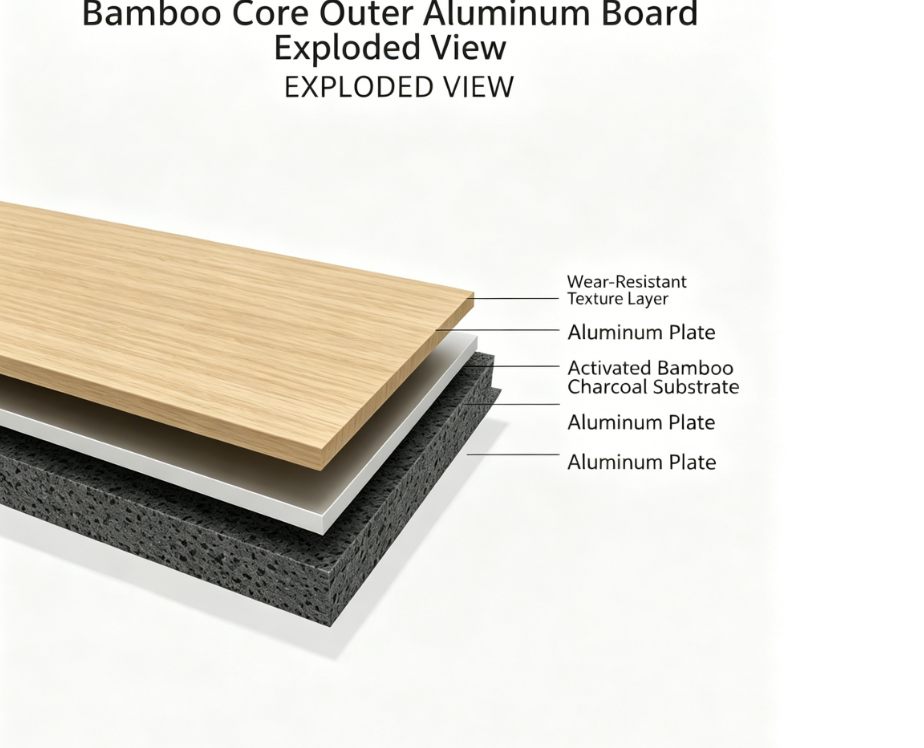
Not every application requires a non-combustible class. Where a project permits a limited-combustibility material, the range offers two products with declared B1 fire ratings. The all-aluminum bamboo core board ZKB-1220×2750 is built on a high-pressure bamboo fibre core hot-pressed with aluminium on both sides, at 18 mm thickness with 5 mm and 10 mm options, aluminium skins of 0.3 mm or 0.5 mm on both sides, and a surface available in spray, wood grain, PETG or melamine; its formaldehyde position is E0 / zero and it is declared 100% waterproof. The welding board WAP-600*(200-700) is an 18 mm aluminium alloy panel, 6 m in length and 200–700 mm in width, with 0.8 mm aluminium skin, 18 available colours, a declared B1 fire rating, zero formaldehyde, 100% waterproofing and a load-bearing capacity of 150 kg/m².
The selection rule that follows is practical rather than promotional. Use the A2 all-aluminum honeycomb panel where the specification or the insurer requires a non-combustible classification. Use a B1 bamboo-core or welding board where the local code permits limited combustibility and the deciding factors are span, weight or a specific core performance. Both paths still need the GB18584-2024 substance position documented, which is why the zero-formaldehyde declaration is repeated across the range instead of being limited to one model.
The supporting evidence file: RoHS, peel strength and management systems
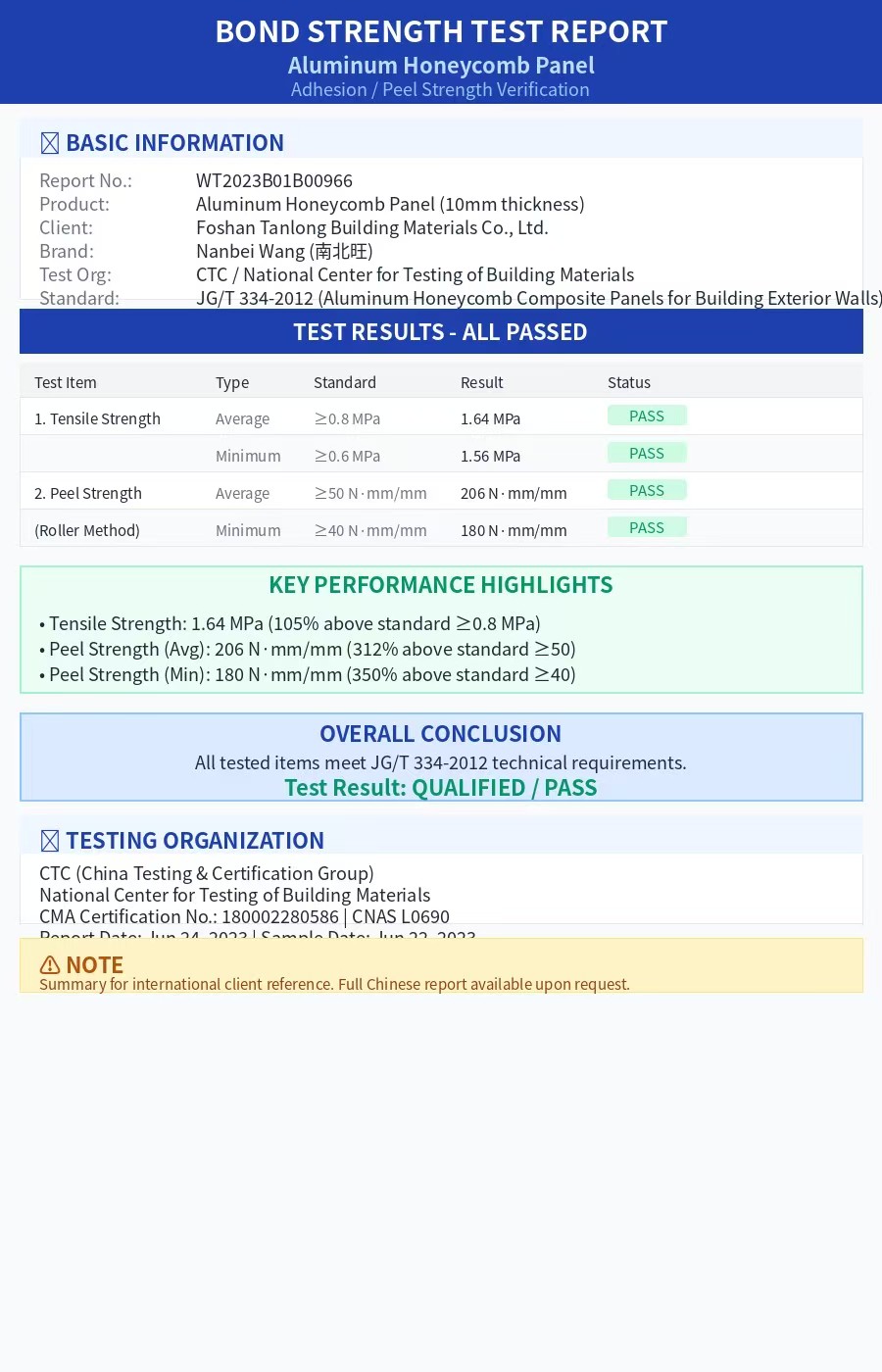
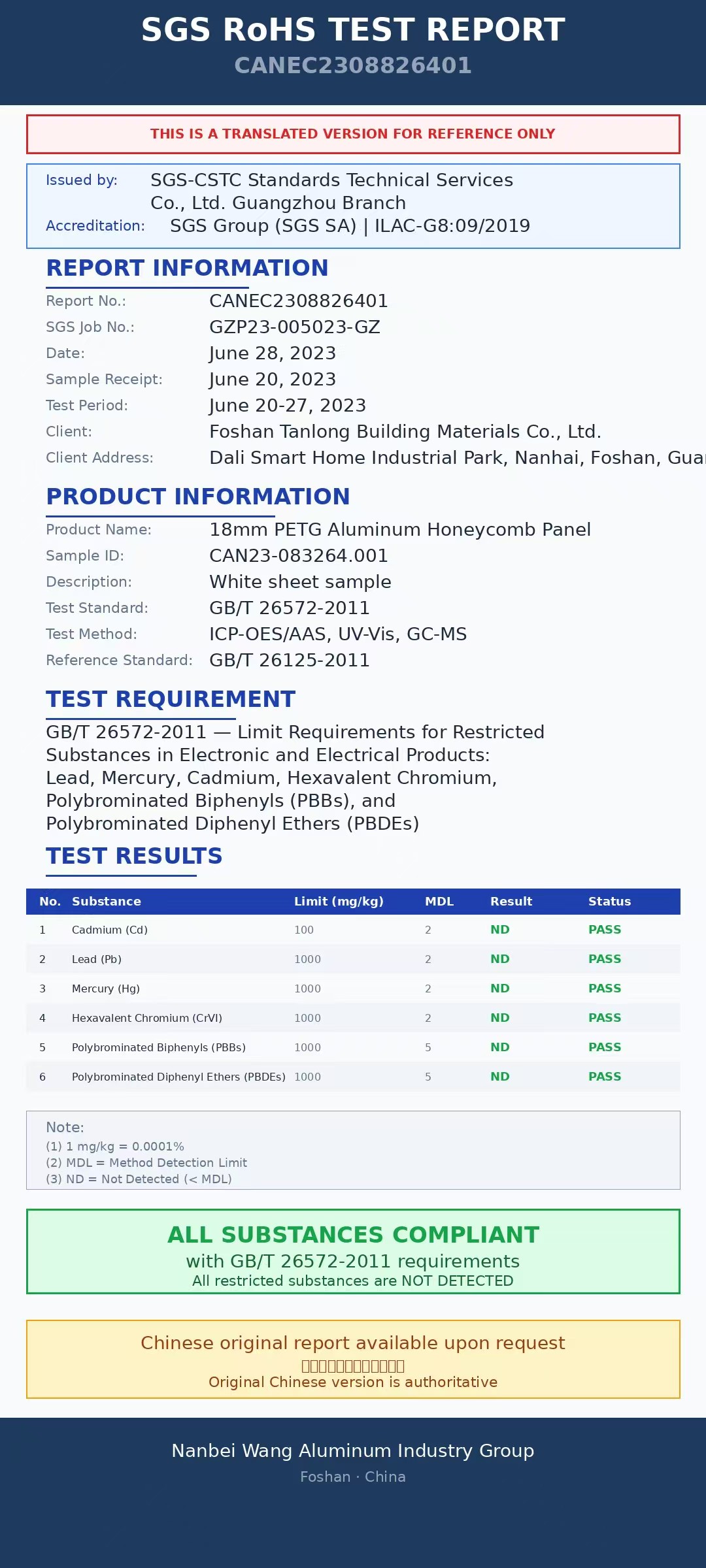
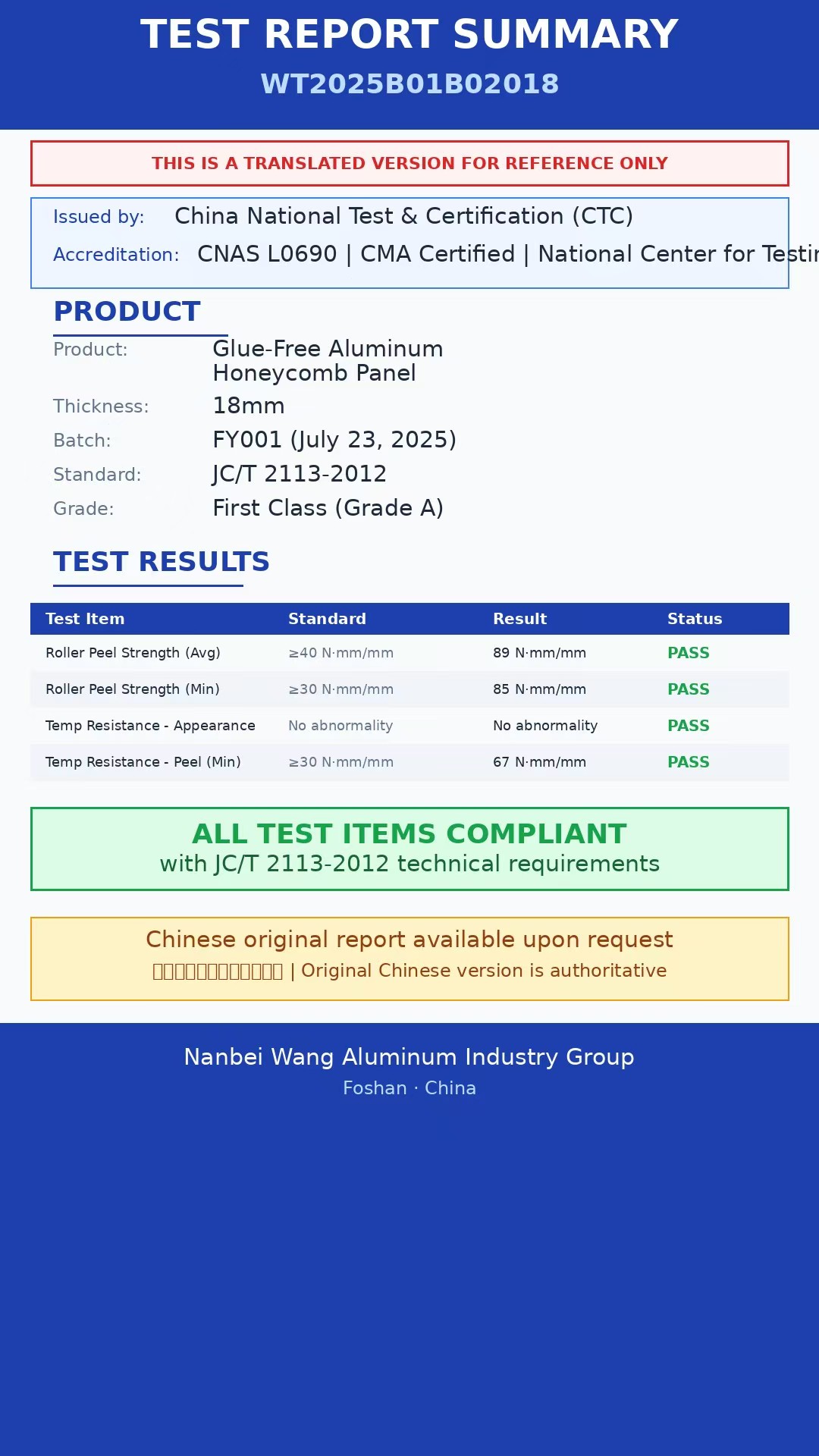
Fire and formaldehyde are the two headline questions, but most tender packages ask for more. Four further documents sit in the same file. The 18 mm PETG Aluminum Honeycomb Panel holds an SGS RoHS test report for restricted substances, number CANEC2308826401, issued by SGS-CSTC Standards Technical Services Co., Ltd. Guangzhou Branch against GB/T 26572-2011 and RoHS Directive 2011/65/EU, covering the six substances Cd, Pb, Hg, CrVI, PBBs and PBDEs with EU, US and Middle East reference applicability. The glue-free aluminum honeycomb panel holds CTC test report WT2025B01B02018, issued by China National Test & Certification (CTC) / National Center for Testing of Building Materials against JC/T 2113-2012, covering peel strength and temperature resistance — the properties that determine whether a glue-free panel holds its bond over years of service. On the systems side, aluminum honeycomb panels for furniture, wall, ceiling and cabinet applications are certified to ISO14001:2015 under certificate BIV25E10066R0S and to ISO9001:2015 under certificate 31825Q10055R0S, both issued by BELIEVE (BEIJING) CERTIFICATION CO., LTD.
Projects that include doors should also note that the all-aluminum interior door NBW-DOR-005 is covered by a formaldehyde emission test report conforming to GB 18584-2001, number SQ2306041 / UNS7332, issued by Guangdong Testing Institute of Product Quality Supervision (GQI) / National Furniture Product Quality Testing Center (Guangdong). The door itself is an all-aluminum integrated structure with a 45 mm leaf and frame, core options of honeycomb, bamboo board or plywood, finishes in PETG, wood grain or powder coating, and frames available in Korean 60 mm, narrow 50 mm, minimalist 25 mm, invisible 55 mm and frameless 18 mm formats — which is why its fire and emission paperwork is worth requesting as part of the same file rather than separately.
Step-by-Step: Verifying a Panel Before You Specify It
The sequence below is the order in which a compliance file is normally checked, and each step produces one document or one answer that can be filed.
- Name the market and the classification first. Decide whether the project requires an EN 13501-1 Class A1 or A2 classification in Europe, ASTM E84 flame spread and smoke data in North America, or a GB18584-2024 substance report for China and CNAS/CMA-referenced submissions. The destination decides which document is the primary one.
- Check the standard edition, not just the standard name. GB18584-2024 and GB 18584-2001 are different editions with different report numbers, even within one supplier's archive, as SQ2505164 and SQ2306041 / UNS7332 demonstrate. A tender that names 2024 needs a 2024 report.
- Match the report scope to your build. Confirm that the tested configuration corresponds to the thickness (5–18 mm for NBW-HPB-001), the aluminium skin (0.3–1.0 mm), the honeycomb core specification (3x3, 4x4, 5x5, 8x8 or 10x10) and the surface finish (PETG, melamine, powder coating or wood grain) that you intend to order.
- Confirm the issuing body and the report number. Guangdong Testing Institute of Product Quality Supervision for GB18584-2024 and formaldehyde testing, SGS-CSTC Standards Technical Services Co., Ltd. Guangzhou Branch for RoHS, and China National Test & Certification (CTC) for JC/T 2113-2012 peel strength and temperature resistance are the institutions named across this evidence file.
- Ask for the current file and the production-stage controls. Validity windows expire and renewal cycles differ, so request the live copy of each document. Pair that with the production controls that keep a certified panel certified: 100% full inspection before shipment with third-party inspection supported, monthly capacity of 50,000+ sheets, an annual output of 1,000,000 sheets from an 80,000 m² plant with 320 employees, and 24-hour sample dispatch to validate the actual build before the order is placed.
Where These Ratings Decide the Project
Compliance documentation stops being paperwork the moment a project type triggers a specific requirement. Four situations recur most often.
- Kitchens, bathrooms and other high-humidity interiors. Here the formaldehyde position and waterproofing carry the argument. The honeycomb panel declares below 1% water absorption over 24 hours, the wall panel is declared waterproof, moisture-proof and anti-mildew, and the welding board declares 100% waterproofing with a 150 kg/m² load-bearing capacity for cabinet and wet-area structures.
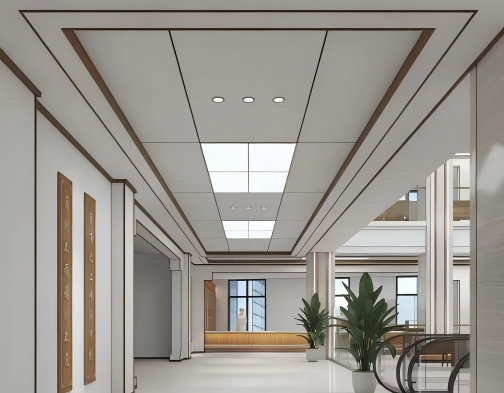
- Commercial interiors, corridors and public-facing spaces. These projects are where a non-combustible classification is written into the specification, and where the A2 honeycomb panel and its glue-free thermal bonding build are most relevant. For reference, an independently verified document file matters more than a product-family claim in this context.
- Hospitality, healthcare and marine interiors. These applications combine moisture, hygiene and fire requirements in one space, and the range is specified for furniture, interior decoration, construction, hospitality, healthcare and marine use. Bamboo-core and welding boards suit structures such as bathroom pods and wet-zone carcasses where B1 is acceptable, while A2 honeycomb panels are used for wall, ceiling and cabinet surfaces.
- Whole-house and distributor programmes. Repeat buyers are buying consistency: the same door, wall and cabinet colour matched across a project, backed by a file that does not change from shipment to shipment. Reported case experience includes a Qatar-based aluminum fabricator taking more than 2,000,000 sheets for cabinet and wardrobe production with 30–50 tons shipped daily, an Indonesian whole-house project of 800,000 sheets reporting stable quality and repeat purchasing, and a broader base of 10,000+ cooperative factories and 5,000+ projects across Malaysia, Saudi Arabia, Singapore, Thailand, South Africa, Kosovo and Kuwait.
Comparison: Standards by Market, and Product-Level Declarations
The first table maps the standards a buyer is likely to encounter against what each one actually evaluates, so that the right document is requested the first time.
| Market / requirement | Governing reference | What it evaluates | What to request |
|---|---|---|---|
| Europe — high-end architecture | EN 13501-1 | Reaction-to-fire classification; Class A1 or A2 are the non-combustible classes | Classification report naming the specific panel build, skin thickness and finish |
| North America | ASTM E84 | Surface burning characteristics — flame spread and smoke development of the core material | Test report stating flame spread and smoke values for the assembly |
| China and CNAS/CMA-referenced submissions | GB18584-2024 | Hazardous substances including formaldehyde | Report number, product scope and issuing laboratory |
| Restricted substances (EU/US/Middle East reference) | GB/T 26572-2011 / RoHS Directive 2011/65/EU | Cd, Pb, Hg, CrVI, PBBs, PBDEs | RoHS report covering the exact thickness and finish supplied |
| Bonding durability | JC/T 2113-2012 | Peel strength and temperature resistance of glue-free honeycomb panels | Test report for the glue-free build, not a generic bonding statement |
The second table sets the product-level declarations side by side. Entries left blank indicate that the parameter is not stated for that model in its published specification and should be requested for the specific project.
| Product (model) | Core / bonding | Fire rating declared | Formaldehyde / hazardous substances | Thickness |
|---|---|---|---|---|
| Honeycomb Panel (NBW-HPB-001) | Aluminum honeycomb, glue-free thermal bonding | A2 | Zero formaldehyde under GB18584-2024; report SQ2505164 | 5–18 mm |
| Whole House Custom Board (NBW-WHB-002) | All-aluminum eco base material, no chemical glue added in the process | Not stated | Baby-grade zero formaldehyde | 5–18 mm |
| Aluminum Honeycomb Wall Panel (NBW-WPB-003) | Aluminum alloy board + high-density aluminum honeycomb base material | Fire-resistant (qualitative) | Formaldehyde-free | 5 / 9 / 10 / 18 mm |
| All-Aluminum Bamboo Core Board (ZKB-1220×2750) | High-pressure bamboo fibre core + aluminum, hot-pressed | B1 | E0 / zero | 18 mm (5 / 10 mm optional) |
| Welding Board (WAP-600*(200-700)) | Aluminum alloy, 0.8 mm skin | B1 | Zero | 18 mm total |
| Aluminum Ceiling (NBW-CLB-004) | High-strength aluminum alloy board + reinforced thickened honeycomb core | Not stated — parameters list moisture and mildew resistance, anti-sagging and seamless splicing | Not stated | Standard thickness |
| All-Aluminum Interior Door (NBW-DOR-005) | Honeycomb, bamboo board or plywood core options | Fire-resistant (qualitative) | GB 18584-2001 formaldehyde report SQ2306041 / UNS7332 | 45 mm leaf and frame |
Declarations above reflect the published product parameters and the test reports held in the supplier's file. Where a project requires a classification or limit that is not stated for a given model, request project-specific documentation rather than assuming transferability between products.
Frequently Asked Questions
Does GB18584-2024 apply to all-aluminum honeycomb panels, or only to wood-based boards?
GB18584-2024 is the hazardous-substance reference used for the all-aluminum honeycomb panel range. Hazardous substance test report SQ2505164 was issued by Guangdong Testing Institute of Product Quality Supervision, applies to the full series of all-aluminum honeycomb panels, and is registered for China and global use. The honeycomb panel NBW-HPB-001 is declared at zero formaldehyde under GB18584-2024. Buyers should confirm that the report copy they receive names the product family, the standard edition and the issuing laboratory.
Can the same panel be supplied in a different thickness or surface and stay within the same compliance documentation?
Customization covers thickness, size, colour, surface finish and cutting, with panel thickness from 5 mm to 18 mm and surface options including PETG, melamine, powder coating and wood grain. Because fire and emission results attach to a specific build, the practical step is to confirm that the report you receive covers the aluminium skin thickness (0.3–1.0 mm), the honeycomb core specification and the finish you intend to order, and to request a project-specific confirmation whenever the build differs from the tested configuration.
What drives the budget of an A2, zero-formaldehyde honeycomb panel?
Four build variables dominate: panel thickness (5–18 mm), aluminium skin thickness (0.3–1.0 mm), honeycomb core specification (3x3, 4x4, 5x5, 8x8 or 10x10) and surface finish. Order structure matters as much as the panel itself — the MOQ starts at 1 sheet, while monthly capacity is 50,000+ sheets on the same production base, so a single validation sheet and a repeat programme sit at opposite ends of the cost curve. Quotation figures are project-specific and are not published as a list price.
Can we receive a sample and the test reports before placing a bulk order?
Yes. Sample dispatch is handled within 24 hours from a 10,000 m² warehouse, and the MOQ is 1 sheet. Test report images are supplied in translated form with the original version available on request, covering the GB18584-2024 hazardous substance report, the SGS RoHS report, the CTC JC/T 2113-2012 report and the ISO9001:2015 and ISO14001:2015 management system certificates. Third-party inspection is also supported on production orders.
What are the lead times, and what is the next step for a compliance-led order?
Stock items ship in 1–7 days and customized production runs 7–15 days, from a base that ships 30–50 tons daily. For a compliance-led programme the usual next step is to send the destination market, the required fire class and the intended panel build, then request the matching report file plus a sample for validation. The 2026 product catalog can be downloaded here: Nanbeiwang Aluminum 2026 catalog (PDF).
Conclusion: Build the Evidence File Before the Order
GB18584-2024 and the A2 fire rating answer two different questions, and a specification is only as strong as the weaker of the two answers. The all-aluminum honeycomb panel NBW-HPB-001 addresses the substance question with a zero-formaldehyde declaration under GB18584-2024 backed by report SQ2505164, and the fire question with a declared A2 rating on a glue-free thermal bonding build, supported by the SGS RoHS report, the CTC peel strength and temperature resistance report, and ISO9001:2015 and ISO14001:2015 certification. Where a project allows limited combustibility instead of non-combustibility, the bamboo core board and the welding board offer declared B1 ratings with E0 / zero and zero formaldehyde positions respectively.
The verification routine is short: name the market, confirm the standard edition, match the report scope to your thickness and finish, verify the issuing body and report number, then request the current file with a sample that matches the intended build.
Next step — sample, quote or full compliance file
Send your destination market, required fire class and target panel build, and the matching report set plus a physical sample will be arranged. Nanbeiwang Aluminum handles sample dispatch within 24 hours, MOQ from 1 sheet, and customization of thickness, size, colour, surface finish and cutting for cabinet, wall, ceiling and door applications.
Contact: Bea — Email 599420378@qq.com | Tel / WhatsApp +86 18138309908
Summer — Email 1739844920@qq.com | Tel +86 18407576890 | WhatsApp +86 13927285115
Message us on WhatsApp | www.nbwaluminum.com | Download the 2026 catalog (PDF)
Have Questions or Need More Details?
Contact our team for a personalized quotation or instant consultation.
Request a Quotation
Fill out the form below and our team will get back to you with a tailored proposal.
WhatsApp Direct Chat
Prefer to chat in real-time? Message us on WhatsApp for instant assistance & quick answers.
- Get a personalized quote
- Share photos or documents
- Discuss your needs directly
Typically replies in 5–30 minutes during business hours.