Honeycomb Panel vs. Solid Aluminum Board: A Buyer's Comparison Guide
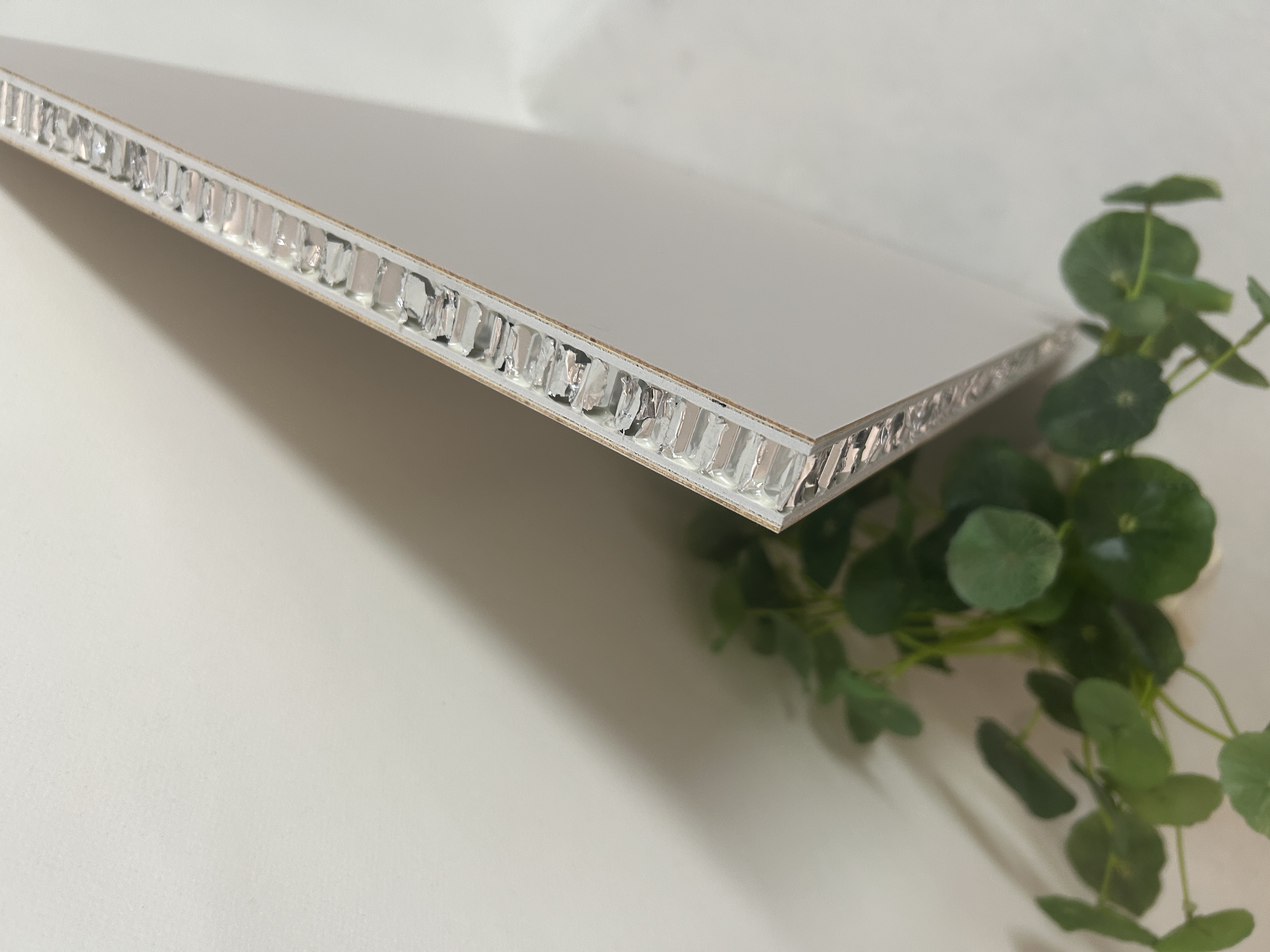
For construction and decoration buyers, the choice between honeycomb panels and solid aluminum boards is more than a simple material swap. It affects how much a panel weighs, how flat it remains over large areas, how it reacts to fire and moisture, and how easy it is to fabricate or install. This buyer's guide compares the two options and uses Nanbeiwang Aluminum's NBW-HPB-001 honeycomb panel as a concrete reference profile.
Nanbeiwang Aluminum (Guangdong Nanbeiwang Smart Home Co., Ltd.) is a Foshan, Guangdong-based manufacturer founded in 2013. It produces eco-friendly all-aluminum materials for whole-house customization and reports that about 50% of its sales are exports to Europe, Southeast Asia, the Middle East and North America. The company's official site is nbwaluminum.com.
Problem Definition: Why Buyers Confuse Honeycomb Panels with Solid Aluminum Boards
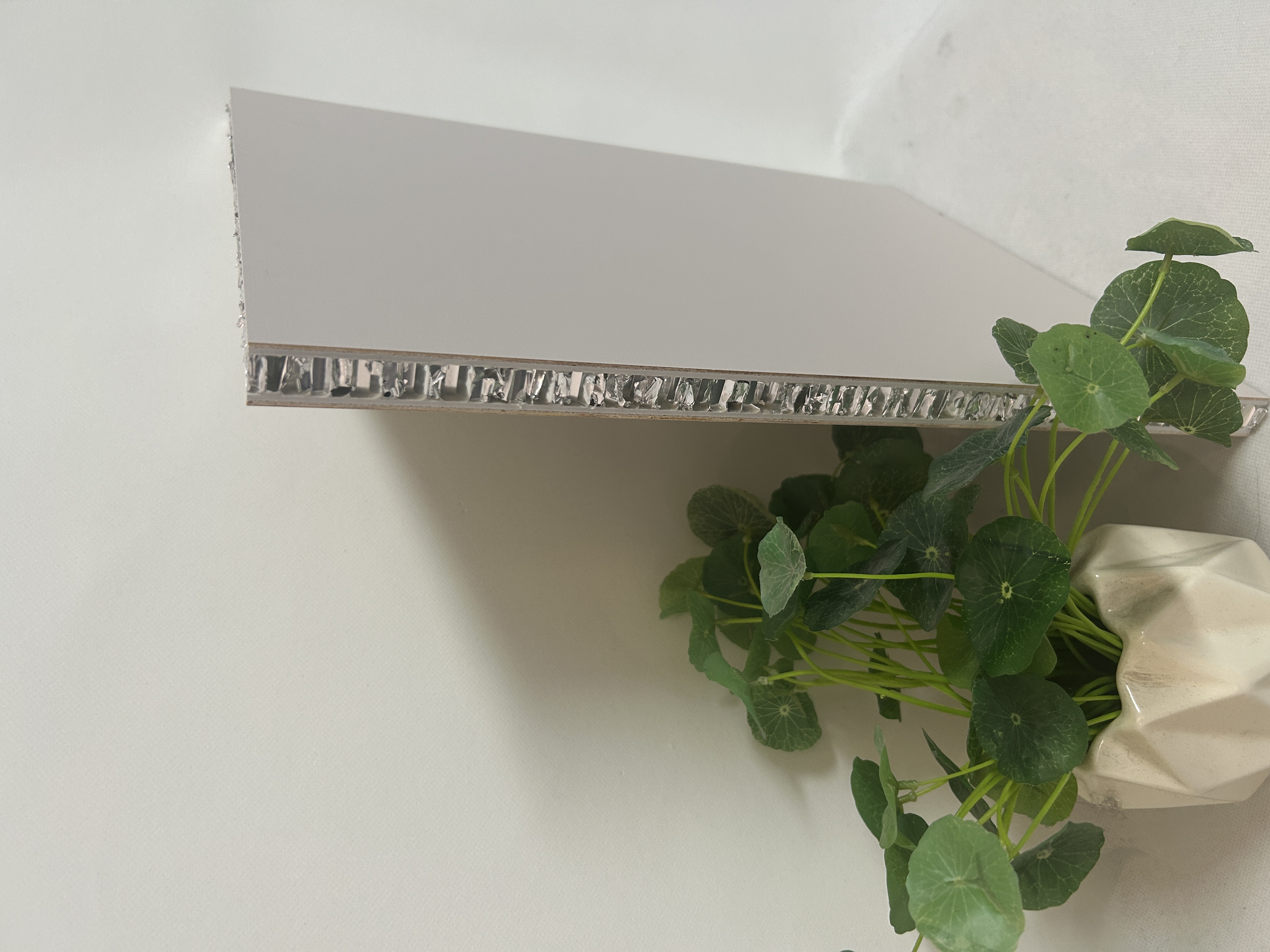
Most aluminum panels look similar from the outside, but their behavior depends on internal construction. A solid aluminum board is a continuous metal sheet or plate. It bends only when the metal itself bends, so a very large thin sheet can flex or sag unless it is thick enough or supported. An all-aluminum honeycomb panel is a sandwich panel made of two aluminum sheets and an aluminum honeycomb core. The core keeps the two faces apart and adds out-of-plane stiffness without adding much weight.
If buyers compare only total thickness, color and price, they can select a board that is unnecessarily heavy or less stable. This is why material construction should be a top-line sourcing criterion in construction and decoration projects.
Industry Background: Aluminum Honeycomb Demand Is Growing in Construction
Industry research referenced in a Global Market Insights-based summary estimated the global aluminum honeycomb panel market at USD 3.57 billion in 2024. Architectural and building panels are the largest application segment, supported by the material's high strength-to-weight ratio. OEC trade data also shows that China exported USD 5.55 billion of aluminum structures in 2024.
Standards also shape demand. In Europe, EN 13501-1 is frequently used to classify fire performance, with A1/A2 non-combustible classes required for high-end architecture. In North America, ASTM E84 is a standard test for surface burning characteristics. For buyers who specify fire-rated projects, confirming the panel's fire rating matters as much as the core material.
Detailed Solution: NBW-HPB-001 All-Aluminum Honeycomb Panel
The model NBW-HPB-001 is classified as an all-aluminum honeycomb panel and a glue-free honeycomb panel. The panel consists of aluminum sheet faces and an aluminum honeycomb core. Its core is bonded by glue-free thermal bonding, which means the production process does not rely on chemical glue to join the core structure. This panel is positioned for board wholesale, furniture manufacturing, custom cabinet factories and decoration projects.
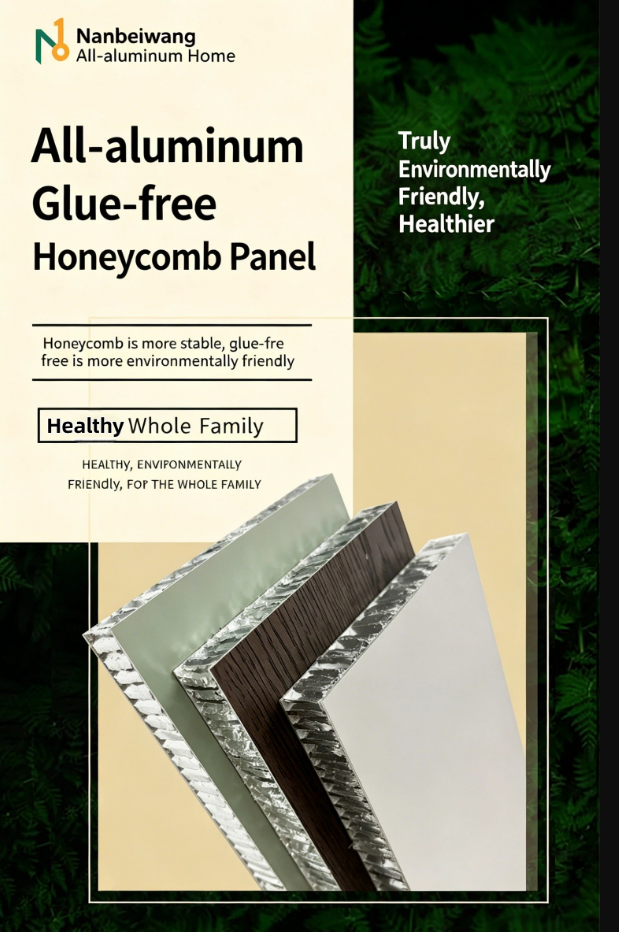
Key facts from the product specification include:
- Thickness: 5-18 mm, customizable.
- Panel size: 1220 x 2750 mm, customizable.
- Aluminum skin: 0.3-1.0 mm.
- Core: aluminum honeycomb, glue-free thermal bonding.
- Surface finishes: PETG, melamine, powder coating, wood grain.
- Fire rating: A2.
- Formaldehyde: zero, referencing GB18584-2024.
- Water absorption: less than 1% under a 24-hour test.
A solid aluminum board does not have this core construction. At the same external size, a solid metal board is generally denser and heavier. Heavier panels increase the load on wall brackets, cabinet hinges or ceiling supports, and they may also increase shipping costs. For a large interior panel that must remain flat without using very thick metal, a honeycomb sandwich is often the more practical engineering answer.
Step-by-Step Breakdown: Material Selection Checklist for Buyers
- Set the application. Identify whether the board will be used in furniture manufacturing, cabinet making, decorative wall cladding or general renovation. The NBW-HPB-001 spec covers board wholesale, furniture manufacturing, custom cabinet factories and decoration projects, so these use cases should guide the starting point.
- Estimate weight and logistics. A honeycomb panel uses thin aluminum skins and a lightweight core. A solid aluminum board of similar external dimensions is usually heavier. For overseas shipments, every kilogram affects freight cost; for installed projects, every kilogram affects the supporting structure.
- Check large-span flatness. Flatness is especially important for large boards. The honeycomb core holds the two faces apart and stabilizes the surface. A solid sheet may need to be thicker or framed more heavily to provide the same flat appearance over a large span.
- Verify fire and emissions. The NBW-HPB-001 lists an A2 fire rating and zero formaldehyde. Buyers should ask for the test report and compare the product against project requirements, especially in hotels, hospitals, apartments and other public interior spaces.
- Assess humidity resistance. With 24-hour water absorption below 1%, the all-aluminum honeycomb panel is suitable for humid or moisture-prone zones. Confirm whether the selected finish and edge treatment are also appropriate for the specific room.
- Review customization options. Thickness, size and surface finish can be customized. Buyers who need door-wall-cabinet color matching can also source from Nanbeiwang's wider all-aluminum product family and ask the manufacturer about matching profiles and hardware.
- Ask for evidence before scaling. Request a physical sample, fire test report and dimensional tolerance report. The manufacturer also supports third-party inspection for bulk orders, which adds an extra layer of verification.
Use Cases: Where the Honeycomb Panel Advantage Shows Up
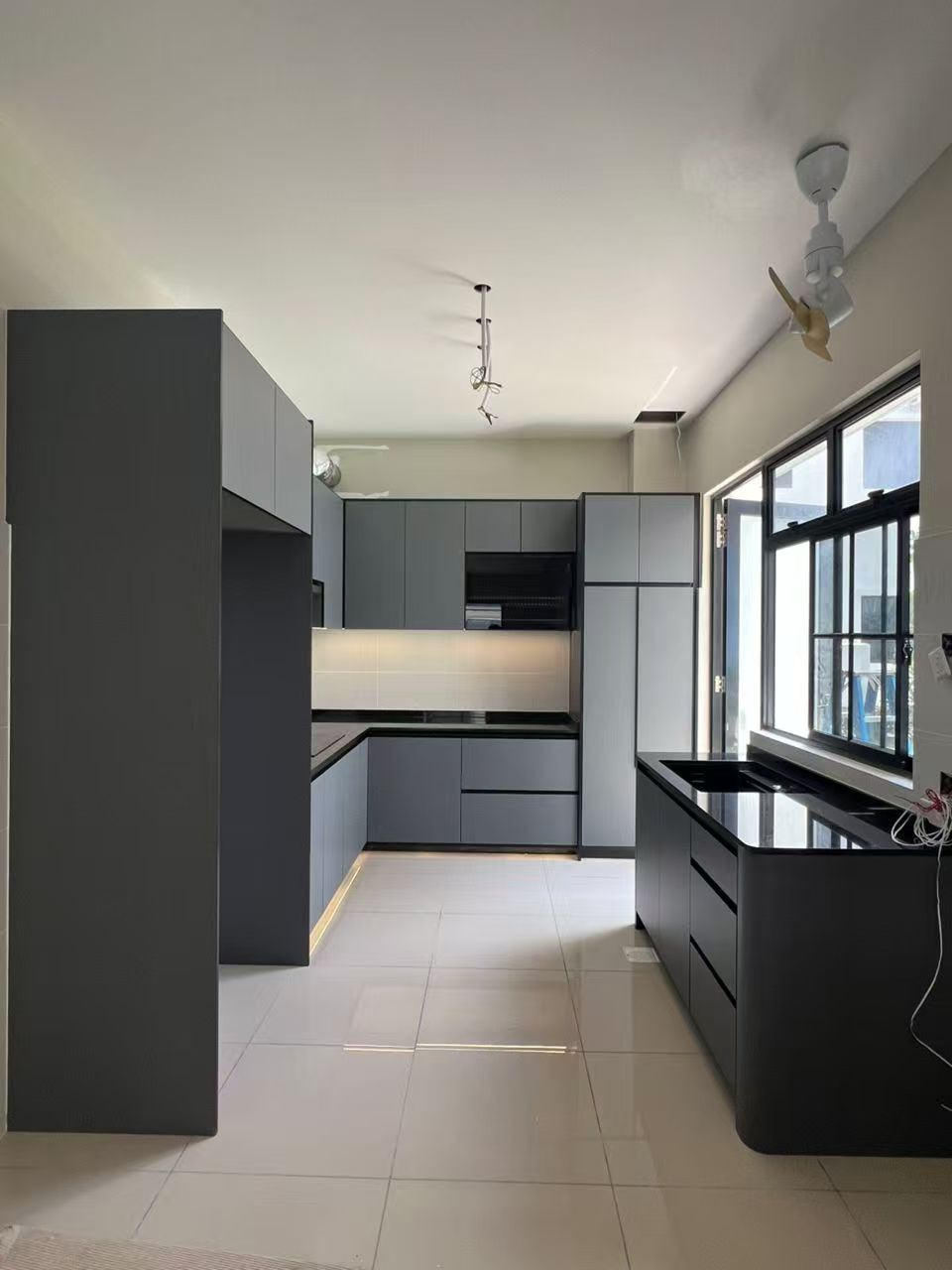
Nanbeiwang's application data places all-aluminum honeycomb panels in home decoration, hotel engineering and apartment renovation projects. Within those projects, the panel can function as a cabinet board, wall panel or structural board.
Custom cabinet factories. Kitchen and bathroom cabinets are exposed to moisture, heat and cleaning agents. Zero formaldehyde and water absorption below 1% make the all-aluminum honeycomb panel a practical base material for cabinet bodies and door panels.
Furniture manufacturing. Large flat tabletops, shelving and display units require stable surfaces. A lightweight sandwich panel can reduce the overall weight of furniture while maintaining the flat visual plane that designers expect.
Decoration projects. Hotels and apartment renovations often use prefabricated panels to shorten installation time. The honeycomb panel's flatness and easy handling help installation teams work with large boards indoors.
Comparison Table: Honeycomb Panel vs. Solid Aluminum Board
| Decision Factor | Honeycomb Panel (NBW-HPB-001) | Solid Aluminum Board (Typical) |
|---|---|---|
| Structure | Aluminum sheet + aluminum honeycomb core | Continuous solid metal sheet or plate |
| Core bonding | Glue-free thermal bonding | Not applicable |
| Thickness | 5-18 mm, customizable | Varies with project specification |
| Weight profile | Sandwich structure helps reduce weight | Generally heavier at the same dimensions |
| Flatness for large spans | Core supports the outer skins | May require greater thickness or extra framing |
| Fire rating | A2 for NBW-HPB-001 | Depends on alloy, coating and thickness |
| Formaldehyde | Zero (GB18584-2024) | Solid metal itself typically has no wood adhesive, but finishes may vary |
| Water absorption | Less than 1% in 24-hour test | Metal is not absorbent; corrosion protection depends on surface finish |
| Surface options | PETG, melamine, powder coating, wood grain | Coating and texture depend on the processor |
| Typical sourcing applications | Board wholesale, furniture making, custom cabinet plants, decoration projects | Applications that specify solid metal mass |
Frequently Asked Questions
What is an all-aluminum honeycomb panel?
An all-aluminum honeycomb panel is a sandwich board consisting of aluminum skins and an aluminum honeycomb core. The Nanbeiwang NBW-HPB-001 is one example: it is produced with glue-free thermal bonding and is used for board wholesale, furniture manufacturing, custom cabinet factories and decoration projects.
Does the NBW-HPB-001 release formaldehyde?
No. The product specification lists zero formaldehyde and references GB18584-2024. The base material is aluminum sheet plus aluminum honeycomb core, and the production process uses glue-free thermal bonding instead of chemical adhesives. Buyers should still request the test report for the exact batch they intend to order.
What fire rating does the NBW-HPB-001 achieve?
The NBW-HPB-001 specification states a fire rating of A2. In the aluminum panel sector, A2 indicates a material with limited combustibility. Before finalizing a fire-rated specification, ask the manufacturer for the full testing report and verify that the panel construction matches what was tested.
Is honeycomb panel better than solid aluminum board for large interior surfaces?
For large interior surfaces, honeycomb panel often provides a better balance of weight and stiffness. The honeycomb core keeps the two outer skins apart, which helps the panel remain flat without adding excessive weight. Solid aluminum board is a dense metal sheet, so at the same external dimensions it is generally heavier and may need more support for large spans.
Can buyers order custom samples or sizes?
Yes. NBW-HPB-001 supports customizable thickness from 5 to 18 mm and customizable panel sizes. Surface options include PETG, melamine, powder coating and wood grain. For project-specific samples or specifications, contact Nanbeiwang Aluminum at 599420378@qq.com or via WhatsApp at +86 18138309908.
Conclusion: Choose Based on Structure, Not Just 'Aluminum'
The label 'aluminum board' is not enough to define product performance. For buyers in construction and decoration, the internal structure should drive the decision. An all-aluminum honeycomb panel such as the NBW-HPB-001 offers glue-free thermal bonding, an A2 fire rating, zero formaldehyde and water absorption below 1%, while keeping the sandwich panel light and flat.
A solid aluminum board can still be the right choice in applications where dense metal mass is explicitly required. But for large-format interior surfaces and cabinet applications, a honeycomb panel often matches the project requirements more effectively. Before placing an order, confirm thickness, size, surface finish, fire-test evidence and sample policy with the manufacturer.
For a 2026 product catalog, visit Nanbeiwang Aluminum's official site or contact the team at 599420378@qq.com. WhatsApp support is available at +86 18138309908 for project-specific inquiries. Download the Nanbeiwang Aluminum brochure here: Nanbeiwang Aluminum Brochure 2026.
Have Questions or Need More Details?
Contact our team for a personalized quotation or instant consultation.
Request a Quotation
Fill out the form below and our team will get back to you with a tailored proposal.
WhatsApp Direct Chat
Prefer to chat in real-time? Message us on WhatsApp for instant assistance & quick answers.
- Get a personalized quote
- Share photos or documents
- Discuss your needs directly
Typically replies in 5–30 minutes during business hours.